 A Little Bit of Stone’s own Kris Grainger was invited to take part in the ‘goings on’ at the Cookery Classroom at last weekend’s Stone Food & Drink Festival when he attended a lesson in Indian Cuisine hosted by the iCookIndian School of Authentic Indian Cookery. Here’s how he got on…
What makes Britain Great is its multiculturalism. Very few other countries in the world can be said to, not only welcome other cultures, but embrace and adopt them as their own. When it comes to embracing culture, there’s no greater affirmation than when a nation adopts and adapts a food to make it their own. Whether it’s going out for dinner or ordering a take-away, Brits are spoilt for choice between Italian, Mexican, Chinese, American or Greek originated food. All of these have been adopted by Brits and tailored to meet the palate or the ingredients available. Ever since the origins of the spice trade, Britain’s have searched for wider and exotic flavours, but there is none more sort after, or more dear to our hearts, than the humble curry.
Whilst having its routes in Indian Cuisine, the word ‘curry’ has no real meaning in India but was coined by the British Army in colonial days gone by. The word was used to describe anything with spices in to cover the fact that ingredients were not keeping well in the heat. Curry as we know it in England, has come a long way since then and although the term is still used as a generalisation to describe all Indian Cookery, the meaning of the word has now shifted from something hot and uncomfortable to eat, to something aromatic, subtle and exotic. The curry house is no longer the refuge of the late-night pub goer but now instead a respectable family-oriented establishment, promoting quality, diverse tastes, a wide-range of choice and levels of ‘spice’ to suit every palate.
One thing you can rely on when the dust settles from a recession, people like to find ways of saving money or ‘making do’ and creating their own. There’s nothing like it for encouraging people to ‘have a go’ or ‘try making it instead of buying it’. Although the worst part of the recent recession seems to be a distant memory, the emphasis it places on cutting back has a lasting effect. Furthermore, skills learnt in these times stay with us and form our future enthusiasms. One such enthusiasm is for cooking. You need only to look at the TV schedules, if it’s not The Great British Bake Off then it’s Rick Stein off on some adventure, The Hairy Bikers, (who themselves have demoed at Stone Food Festival), cooking up something wherever they find themselves, Jamie Oliver showing us how you can cook things in your own home or Saturday Kitchen bringing a mish-mash of cuisine from around the globe, all to your breakfast table. Tony Singh and Cyrus Todiwala have, in recent weeks helped to encourage and popularise the idea of cooking Indian food at home with their adventures on the programme and I, like many others, have been tempted to try my hand at Indian cuisine but with little success or the inevitable disappointment that food doesn’t taste as good as the local Indian restaurant or take-away.
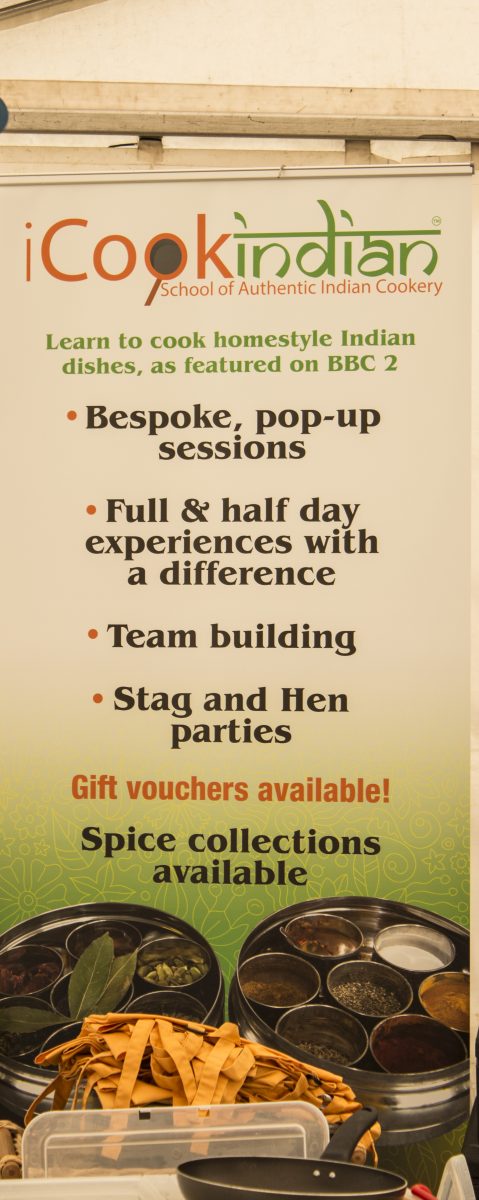 It was with many past disappointments under my belt that I began thinking that I would never master the true secrets of Indian cookery. Imagine my delight then when I was asked if I’d like to take part in iCookIndian’s cookery class at this year’s Stone Food & Drink Festival.
iCookIndian is a relatively new company, having had their one-year anniversary at this year’s festival. Founder and teacher Amarpal Harrar told me ‘This is a very special event for us, our company began exactly a year ago this weekend. At first we didn’t know if there would be demand for people wanting to cook Indian in their own homes but we’ve been absolutely overwhelmed by the response.’
Amarpal spent his childhood in Punjab, India and learned to cook by watching his mother. He remembers with fondness the exotic tastes and sights of the village food vendors and now helps his students recreate many of the foods that shaped his early experiences. Indian cooking has remained a huge part of his family life, and the whole family work as part of the business team.
He told me a wonderful story about how easy it is for people to cook Indian in their own homes, just with a little guidance in the right direction, ‘Phil Taylor, the World Darts Champion, came to one of my classes’, he continues, ‘now he takes his spice tin and portable stove with him everywhere in the world he goes, and messages me, telling me which local ingredients he’s cooking in his hotel room or on the beach’.
Often when you approach a country’s cuisine, as an outsider, it can be intimidating to think of the complexities of the food, imagining it to have many ingredients or a series of complicated techniques. The more I travel and the more I experience cooking in other countries, not in the restaurants but by families, the more I find that the heart of any country’s food is usually simple, good quality ingredients and just a little know how. Long gone are the days of Cordon Bleu’s unrealistic approaches to world food, to be replaced by a new world approach dominated by the local fresh produce, family values and ‘mamma’s’ cooking.
Amarpal explains to me that Indian cooking is no different,
‘People often think there’s a secret ingredient that makes a take-away quality dish. There is no secret other than less is often more. Too many ingredients or too much of everything creates overpowering and indistinct flavours; you’ve got to be able to taste the ingredients, not just the spices, too many spices and you can’t tell them apart’.
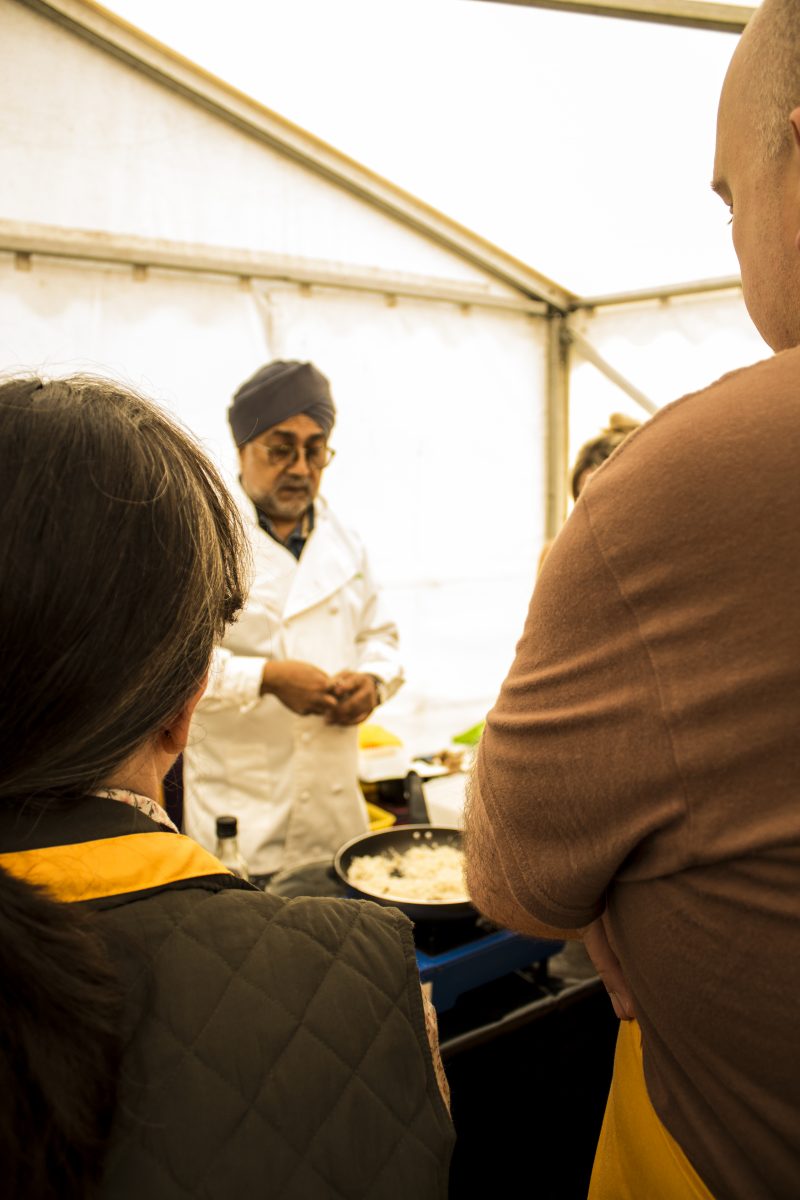 As I approach the festival’s Cookery Classroom, I can’t help but be reminded of the Bake Off tent with the work benches laid out in neat rows with everyone facing ‘The Male Judge’; ‘let’s hope nothing goes in the bin today’, I can’t help thinking to myself.

Amarpal and his team give me a warm welcome and invite me and the other students to choose a workstation. Once settled in and aproned up, we are told we have an hour to learn how to make, and produce 4 items. Not only that, but we would be able to take our food home with us after the session! This makes me immediately think that this was going to be an intense and pressured experience – nothing could be further from the truth. The whole experience was relaxed and set at a great pace with easy to follow demonstrations followed by a chance to try our hands at the dishes ourselves. I found myself with a huge grin on my face throughout the hour as I was made to feel confident in the things I had by shown by this skilled tutor.
Starting with a tour of the spice tins, known as Masala Dabbas, Amarpal guides us through the different ingredients, their origins and the type of dishes that they can be used for, from cumin and turmeric to the bark of a cinnamon tree, via cloves and cardamom to curry leaves, there’s an array of spices to choose from. We then move onto a demonstration of the correct way to make pilau rice, completely opposite to the way I had been doing it, followed by us all being issued with the ingredients to make naan breads. Now anyone who knows me will know that I’m a keen amateur baker, I have been known to frequent Stone’s own Stone Baked in the evenings just to share tips and tricks, (and steal the odd tea-cake – oops), but naan bread was something I’ve never dared to brave making. Under Amarpal and his team’s guidance, we were making them in a manner of minutes and I’ve made some at home since too; no recipe or weighing required!
Throughout the session, the team would impart bits of information or history about the food, and little gems of facts such as ‘tomato is a glutamate, a flavour enhancer, and much better for 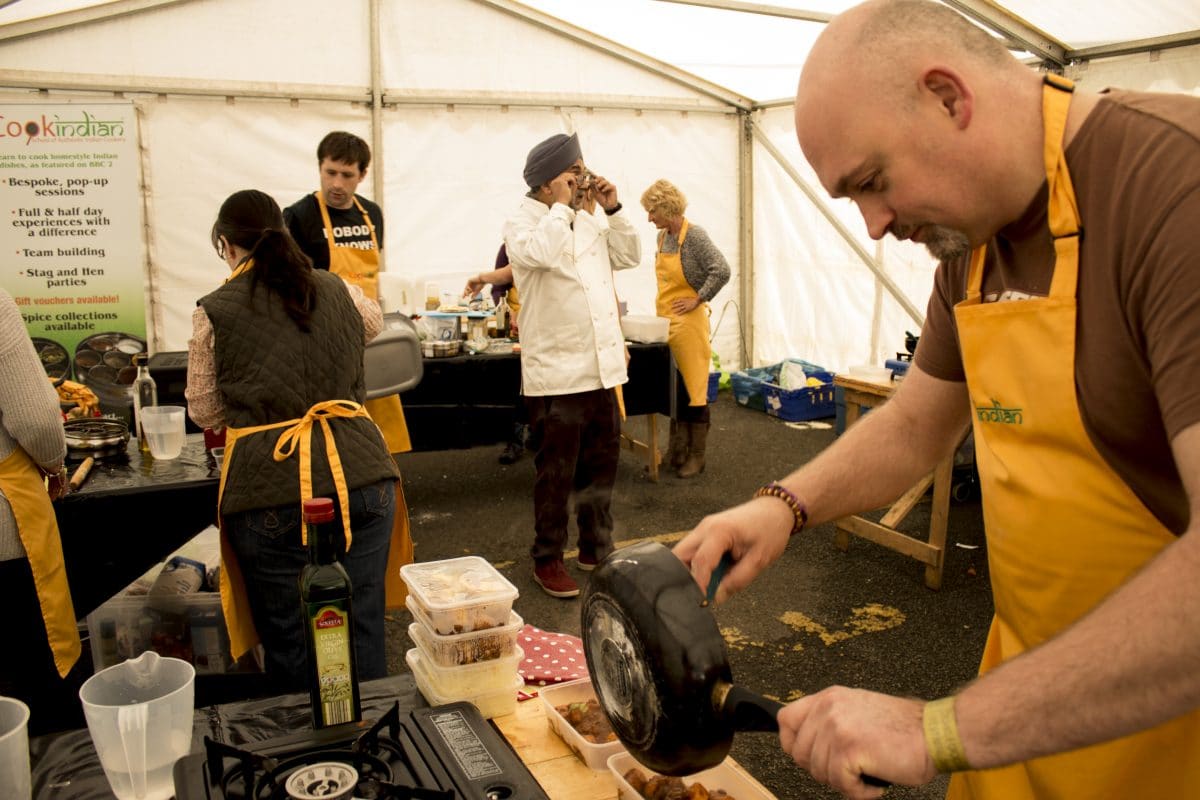 you than the artificial Monosodium Glutamate.’
The simplicity of cooking these dishes continued throughout the hour and during this time we managed to make Naan breads, Pilau Rice, Aloo Gobi and Chicken Rogan Josh. I never would have thought that was possible in the time and I’m pleased to say I’ve made it all at home since and completely from memory. Recipes were available all weekend from the boys tending the iCookIndian stand in the main tent and after the session I went to get mine.
I took my food home, but many sat and ate theirs straight after the session. Amarpal told me, ‘This has just been a taster really, our courses are normally a half-day. Think what you’ve done in an hour and imagine what you can do in half a day!’
Overall the course was extremely enjoyable, the teaching staff were friendly and helpful and the food tasted de-lici-ous. Anyone with a love for Indian food and an interest in cooking it for themselves should definitely look into iCookIndian’s courses.
iCookIndian’s new home is in the Teaching Kitchen at Stafford Sports College on the Wolverhampton Road in Rising Brook, but they are what Amarpal refers to as a ‘pop-up college’ meaning that they can take their teaching when and where it is in demand; be it for individuals, small groups of enthusiasts or for company training. Their website allows you to browse and book courses, order spice tins and ingredients and even buy course gift vouchers for friends and loved ones; put me down for one please!
They are on Facebook and Twitter and their website is www.icookindian.co.uk
Kris Grainger (Photos by Marlane Clarke)