

Origins of Stone, Staffordshire
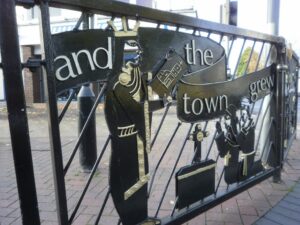
According to legend, Stone owes its origin to the murder of two Saxon Princes, Rufin and Wulfad, the sons of Wulfhere, King of Mercia, from 659 to 675 AD.
Wulfhere lived in a fortified hill fort about two miles from Stone. Originally a pagan, he converted to Christianity on his marriage to Ermenilda, the daughter of the Royal and Christian house of Kent. Wulfhere later reverted back to paganism, and although he allowed Ermenilda and their daughter Werburgh to follow the Christian faith, he forbade his two sons, Rufin and Wulfad, to become Christians.
According to the legend, the two princes followed a white hart whilst out hunting, which led them to St. Chad, who preached to them, and eventually, he baptised them. Having discovered that the princes defied his wishes, the King swore that he would kill them.
The two Princes fled the hill fort, and the king rode after them, and he killed Wulfad at Stone and Rufin at Burston. As was the Saxon custom, the bodies were buried together, and a large cairn of stones was placed over the grave.
The king later sought absolution from St. Chad and allowed the Queen to build a small priory on the site of the Princess’ grave. Around this, a small village started to grow, originally called Staines but changed over the centuries to Stone.
The priory was largely destroyed by invading Danes but was re-established in the 12th century. The priory was one of the first to close under the Dissolution in 1537.
The seal matrix from the priory was discovered in a field in Cobham in August 2011. Following a public appeal, it was purchased and is now on display in St. Michael and St. Wulfad’s Church.
Famous People Associated with Stone
John Jervis, Earl St. Vincent – the victor of the sea battle of 14th February 1797 against the Spanish at Cape St. Vincent (off the coast of Portugal) was born at Meaford Hall near Stone and is buried in the family mausoleum at the rear of St. Michael and St. Wulfad’s Church.
Thomas Bakewell – was a poet and pioneer in the treatment of the mentally ill. He ran a private asylum at Springvale near Tittensor and wrote numerous papers on his pioneering treatments. He married 3 times and, by his various wives, had 24 children. He is buried in the churchyard at St. Michael and St. Wulfad’s church.
Peter De Wint – it is traditionally believed that the landscape artist was born in Stone on 21st January 1784. Some of his earliest works are of views around Stone.
Henry Fourdrinier – who redeveloped the paper-making machine, which revolutionised the paper-making industry in Britain. He lived at Burston Hall and is buried in St. Michael and St. Wulfad’s churchyard.
Richard (Stoney) Smith – was born at the Mill (now a restaurant) in Mill Street in 1836. He developed a flour originally known as Smith’s Patent Wheatgerm Flour it was later given the name Hovis.
William Percy Austin – was born at the Crown Inn, Stone on 7th November 1807. He became a priest and went to British Guiana. He later became the first Bishop of Guyana and in 1844 founded Queen’s College in Georgetown.
Rev. Stebbing Shaw – was born in Stone in 1762 and is regarded as the first historian of Staffordshire.
Cardinal John Henry Newman – preached the sermon at the dedication of the nave of the Roman Catholic Church of the Immaculate Conception and St. Dominic in Stone and presented the processional lights to the Sisters at the convent which are still used today.
William Bernard Ullathorne – the first Roman Catholic Bishop of Birmingham, is buried in the transept of the Catholic Church in Stone. It was through his drive, dedication and enthusiasm as Archbishop of Birmingham in the early days when the Roman Catholic hierarchy was re-established in England that the new diocese of Birmingham flourished and Catholicism spread throughout the area.
Dominic Barberi – An Italian theologian and a member of the Passionist Congregation. He came to Aston Hall in February 1842 and, from there, came to Stone to preach to the growing number of Roman Catholics. At first, he held services at the Crown Hotel, and later, he built St. Anne’s Chapel. He was beatified by Pope Paul VI in 1963.
Sister Elizabeth Prout, (known as Mother Mary Joseph of Jesus) – She was born in Shrewsbury and came to Stone when her father worked at Joules Brewery as a journeyman cooper. It was in Stone that she was converted to Catholicism. She later went on to found the order of the Institute of the Holy Family, and later known as the Passionist Sisters or the Sisters of the Cross and Passion.
Cedric Price – the architect and writer on architecture was born in Stone on 11th September 1934.
Eva Morris – who held the record of being the oldest person in the world from December 1999 to her death at the age of 114 in November 2000, lived in Stone.
Recent Sporting Personalities Associated with Stone
Richard Munro Fox, the British born Australian Slalom Canoeist lived in Stone for a period and trained on the River Trent: Stan Collymore was born in Stone; the footballer Chris Birchall went to Alleynes High School and Lizzie Neave the Olympic canoeist lived and trained in Stone for a while.
Joe Clarke, who picked up gold at the Rio Olympics in 2016, is from Stone and trained at the Stafford and Stone Canoe Club.
Traditional Industries of Stone
From the 12th century when beer was brewed by the monks from Stone Priory the town was famous for the quality of its beers until the last brewery closed in 1974. However the industry has recently been re-established by the opening of the Lymestone Brewery.
Shoe making was another one of the old traditional industries associated with Stone.
Agriculture played an important role in the town, and at one stage, there was a weekly cattle market and an annual cheese fair.
All these industries are depicted on the Town Crest of Stone.
Canal Town – Stone is known as “Canal Town” as it has played a major role in its development. The first meeting of the Grand Trunk Canal Company (later the Trent and Mersey Canal Company) was held in the Crown Inn (the forerunner of the Crown Hotel) on 10th June 1766. At this meeting James Brindley was appointed Surveyor General of the project. In 1767, the Canal Company located its headquarters in the town due to it being at almost the Centre of the canal (the actual halfway point is at Aston Lock). The arrival of the canal, according to a contemporary record, “transformed the town from a sleepy market town into a busy inland seaport.” Although very little freight is carried on the canal today, it is extremely popular with holidaymakers.
The Coaching Era – Stone was on the main road from London to the northwest, and at the height of the coaching era, 38 coaches a day passed through Stone. The town’s principal inn was the Crown, the present building of which was designed by the famous architect Henry Holland.
Contributions from Stone Historian – Philip Leason