
This is the first of a regular series of features on Stone’s creative community. We’ll be putting artists, makers, musicians and more in the spotlight. Our first feature has been written by poet Jo Bell, who went to see well-known local artist Emma Joustra in her home studio. Photographs are by Daniel Moore…
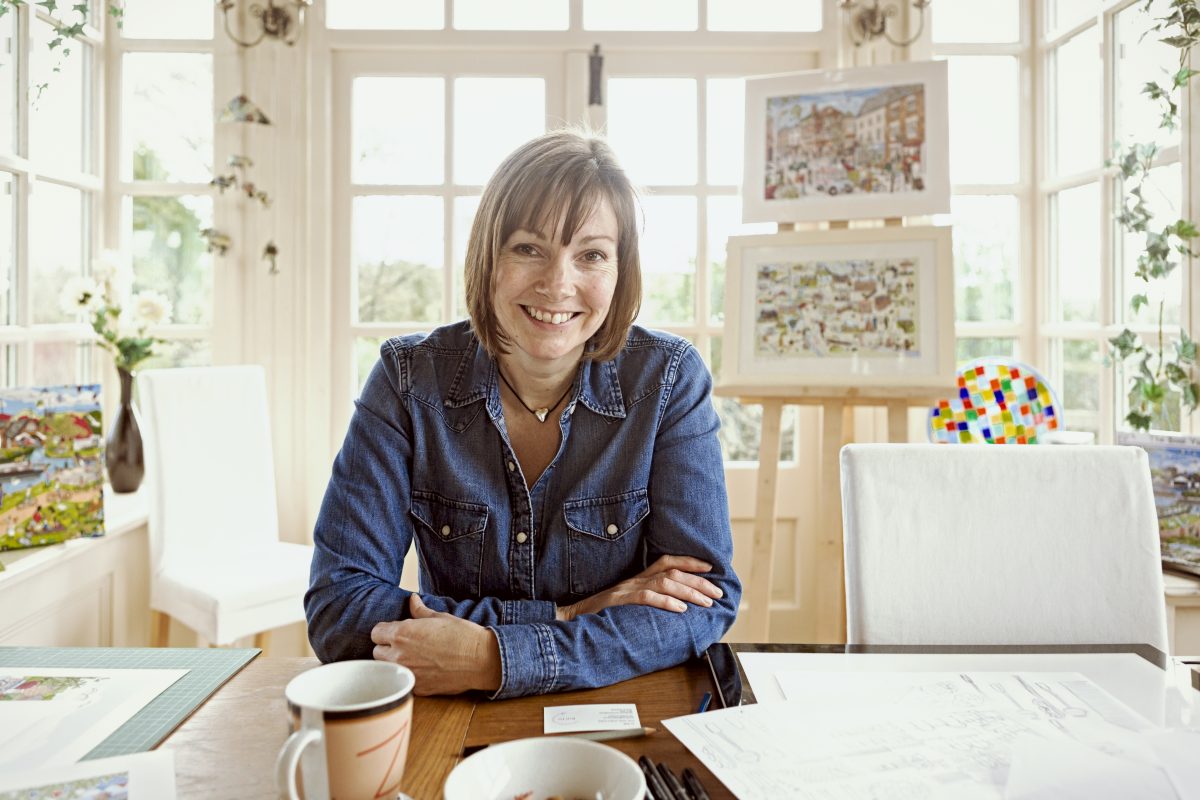
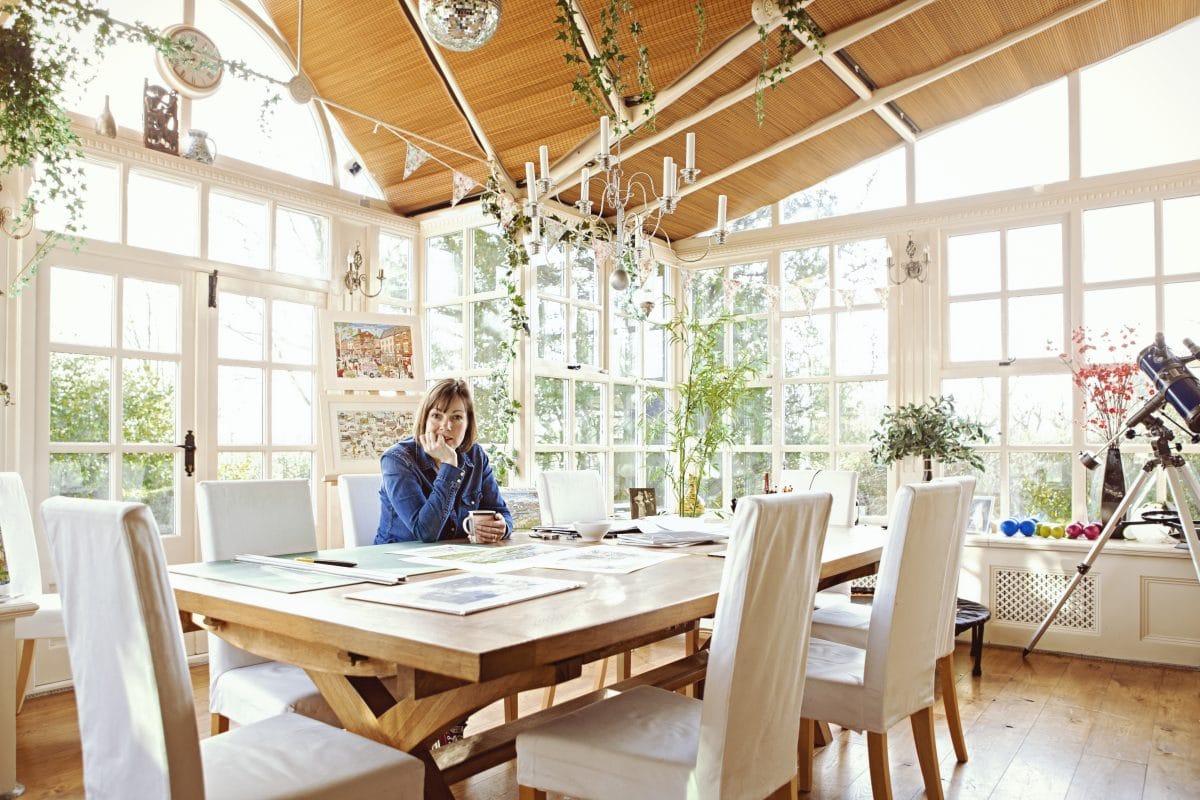
[dropcap]‘W[/dropcap]hen I revamp my website,’ says Emma Joustra with a smile, ‘the first thing I’m going to put on it is how to pronounce my name.’ For the record it’s YOW-STRA – her husband is half-Dutch. The site is called ‘It’s a Colourful Life’ and Emma’s art, strewn across a table in her sunny conservatory, is bright with vivid colours.
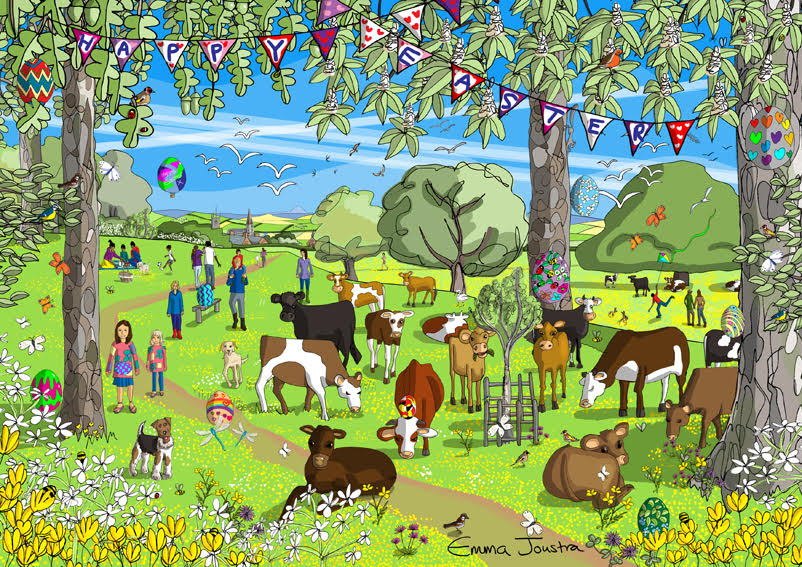
Most of us in Stone have seen Emma’s work in local shops or homes – and now, as the logo for A Little Bit of Stone. It’s stylised, even cartoonish. Looking at a Joustra picture is not a passive experience. They engage the viewer almost like a film, full of characters and events. The buildings and landmarks are a deftly-drawn backdrop, but in Joustra’s Stone the streets are always teeming with people, dogs, jolly vehicles and visual jokes or unexpected celebrities. Humphrey Lyttelton plays the trumpet outside Granville’s; a traffic warden tickets a parked car, a nun from St Dominic’s enjoys a walk. ‘What I hope people feel is that they would like to be in the paintings – that the pictures look like a happy place to be,’ says Emma.
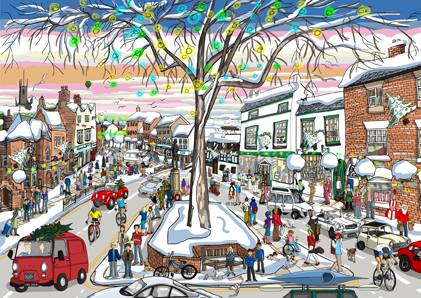
‘I never have an idea of what it will look like. You might have a rough idea that it needs something in the foreground but, for instance, you don’t know whether it’s going to be a VW camper van or an old fashioned ice cream van.’ Vintage cars appear frequently but a picture, says Emma, needs to have people in it too, and her pictures are full of local faces, people we can identify. Her Stone is also a broader and perhaps better town than the one we actually inhabit. Am I imagining it, or are there more black faces, more wheelchairs and guide dogs, more signifiers of a multicultural place than we’re used to seeing on the real high street? ‘Yes, I do that deliberately,’ says Emma. The many cats and dogs ‘add a little bit of chaos – and they are useful for filling a space!’ Her favourite is the cat making its way across the roof of Granvilles, in a picture of Granville Square at night.
That one, she explains leaning over it, started as a picture of the square in daylight, but halfway through making it she saw that night-time would serve her purpose better. ‘Set in daylight, it was really just a picture of the buildings,’ says Emma. ‘But it really comes alive on a summer night, and that changes the story of the painting – it’s no longer just about Granvilles, it’s about nightlife.’
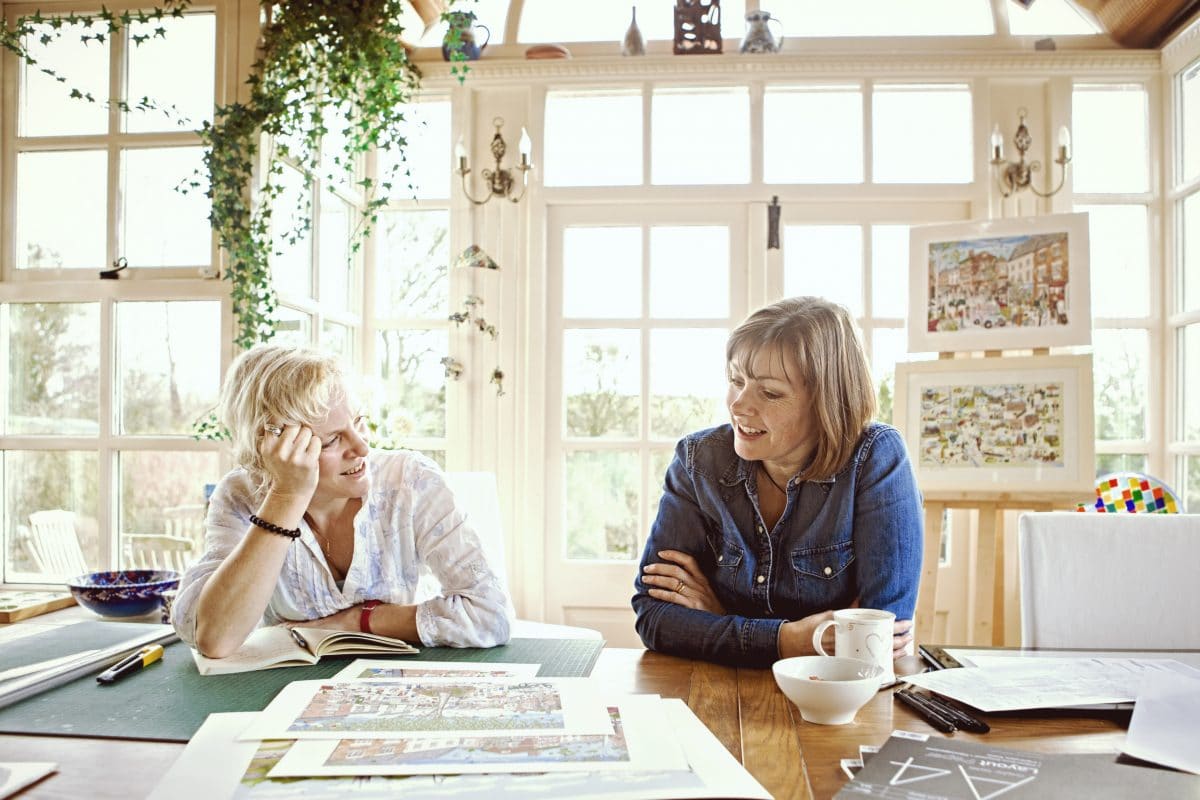
At this stage, had she been colouring the image by hand with marker pens as she used to do, Emma would have had to start all over again. When she started in 2008 she did it that way, but found it an expensive and time-consuming way to work. Now her pictures are produced by the giclé method – ‘just a posh new way of printing.’ She starts by sketching the buildings with pen and ink, then scans the hand drawing into a computer. From that point onwards the colouring is done not with paintbrush or ink, but digitally. Occasionally this raises the hackles of a more conservative critic. ‘The only snobbery I encounter,’ Emma winces, ‘is when people hear that I colour them digitally – but they have no idea how much craft is involved in the process. I love David Hockney who champions the iPad and says that all the Old Masters would have used it if they could. If I was writing a novel, I’d be doing it on a word processor nowadays so why not use the available technology?’

So the picture became a night scene, and one of Emma’s most popular works. WH Smith even used it for a jigsaw. Granville’s itself is owned by Emma’s brother Adam, and her family often features in her work – ‘I always put my family in the pictures – me and Marten and the boys, somewhere.’ That commitment to people and place makes her endearing to Stone buyers. ‘People like spotting things that they recognise’, says the artist. I confirm this by pointing out that in a painting of the Canal Cruising boatyard she has faithfully captured the pump-out truck – the tanker that empties narrowboat toilets. She squeals with laughter. ‘Oh, I’m so glad that I got that in! I had no idea what it was!’

[dropcap]E[/dropcap]mma’s path to creative work came via a series of wrong turns. ‘If I’d gone to art school,’ she says, ‘ I would have been doing something entirely different. The way I draw would have been trained out of me.’ At school she was advised to study English. It’s a familiar and frustrating story. ‘I wanted to be an artist, but at school I was discouraged. In this area, really creative, the Potteries – why didn’t the teachers encourage me to get myself into the factories?’ She was briefly a teacher but missed drawing, and made a brief foray into advertising. As it turned out, that career was not for her either, ‘but it wasn’t wasted. I started using story boards, and drawing with marker pens, and I came back to art through that. That path led me here. I literally just do it all by eye, and it’s sometimes skew-wiff, but people like it for that. I would never call it high art.’ The result feels lively and spontaneous – the wit of Beryl Cook, with the colour and fine detail of Clarice Cliff. The sense of work and bustle has been compared to Lowry’s scenes of workers streaming from the mill gates, and there is a joyful flavour of folk art in it.
Nowadays, the giclé work is Emma’s bread and butter – particularly drawings of private houses. She visits each one, takes photos and interviews the owners. The finished picture might include glimpses of a violin or a football shirt. The finished work is effectively a portrait of both building and owner, and reaffirms the connection between artist and environment. It’s clear that she’s a dedicated and ambitious worker, but she’s quick to acknowledge those who have supported her – ‘A Little Bit of Stone and the Stone Gazette have been immensely helpful, and I believe that you have to give something back to the community you belong to.’
The next few months may see Emma Joustra reaching further afield for new subjects and new media. She still has an eye on local landmarks like Joule’s Brewery and the Star Inn, but knowing the town almost brick by brick now, there is an appetite for new towns and cityscapes to add to her portfolio. She sounds apologetic – ‘I love Stone and I don’t want people to think I’m ungrateful to it, but it would be nice to spread my wings in other places too.’ A trip to the capital might be in order: drawing its buildings, Emma speculates, would be one way to get to know it better. Her giclé work is being made into products like tiles and maps, but she is ready to get her hands dirty again with other art forms. ‘I do miss working with acrylic paint – the work I used to paint was really massive, splashy and colourful.’
If viewers recall the children’s books of Richard Scarry or the Where’s Wally paintings, Emma is happy with the comparison; ‘People always say that every time you see one of my pictures, you spot something new,’ and she enjoys the idea that children who see her pictures in local restaurants might remember them for years to come, as she remembers the Scarry books. Her current project is work for the new Haywood Hospital in Burslem, which will soon be displaying her pictures of Potteries landmarks like Arnold Bennett’s house, the Leopard pub and Burslem School of Art. As ever, the new works will balance the architectural and the personal in her distinctive wobbly style. ‘My perspective is always a little bit off, I have a lazy eye and maybe that’s why!’ she jokes, but she knows that her reputation is growing. ‘I just feel lucky all the time. I just can’t believe that people like my style. I didn’t go out there with the intention of making that happen.’
Emma Joustra doesn’t aspire to ‘celebrity artist’ status, but clearly takes pleasure in the pleasure that her work gives to others. ‘I love it when people say ‘Your work makes me smile,’ she says. Catching a glimpse of her work on someone’s living room wall, or in a narrowboat on the local canal, gives her a thrill of recognition. If that sounds as if she is looking a little too closely at other people’s homes, who can blame her – that eye for detail is what makes her art so entirely her own, and so well loved.
Let us know if you’d like to be featured in a future Creative Stone article, or if you’d like to write one for us. Email jamie@alittlebitofstone.com