

Plans have been submitted for the Former Maltings, the Grade II listed building that has sat empty for years and caused the closure of Adies Alley in April. The proposals go well beyond patching and propping. If approved, they would leave the building watertight, structurally secure and ready for its long intended future as part of the Crown Hotel.

The building sits on one of the main pedestrian thoroughfares into Stone High Street, leading past Griffins of Stone, Mud Pottery Studio and The Secret Tea Room. When the alley closed without warning in spring, the effects were immediate for the three businesses operating in Adies Alley.
The new application sets out in clear detail what has gone wrong and how deep rooted the problems are. It also outlines the repairs needed to bring the building back to life after more than a decade of damp, cold and neglect.
A building that has waited too long for help
Although parts of the Maltings received attention in 2021, the structure beneath continued to deteriorate. The flank wall along Adies Alley is the most obvious issue. Over time the masonry has pushed outward, creating a visible lean that could only be held temporarily by scaffolding. Engineers have recorded the outward bow as significant enough to warrant dismantling the wall entirely before it can be rebuilt.
Inside the building, the story is similar. Timber beams have softened or crumbled where moisture has gathered in unventilated corners. Floorboards have lifted or given way and several joists show long standing woodworm activity that has left them hollow. The timber survey that has been filed with the planning applications describes a structure that has simply run out of strength.
Yet the building retains surprising character. Thick brick piers survive on the ground floor and the kiln room, possibly the most unusual feature of all, is still largely intact. The double wall structure and suspended drying floor remain in place, even though the space around them has become dark and dusty. The heritage statement that accompanies the application describes the kiln as a rare survivor of its type.
A clear plan to make the building sound again
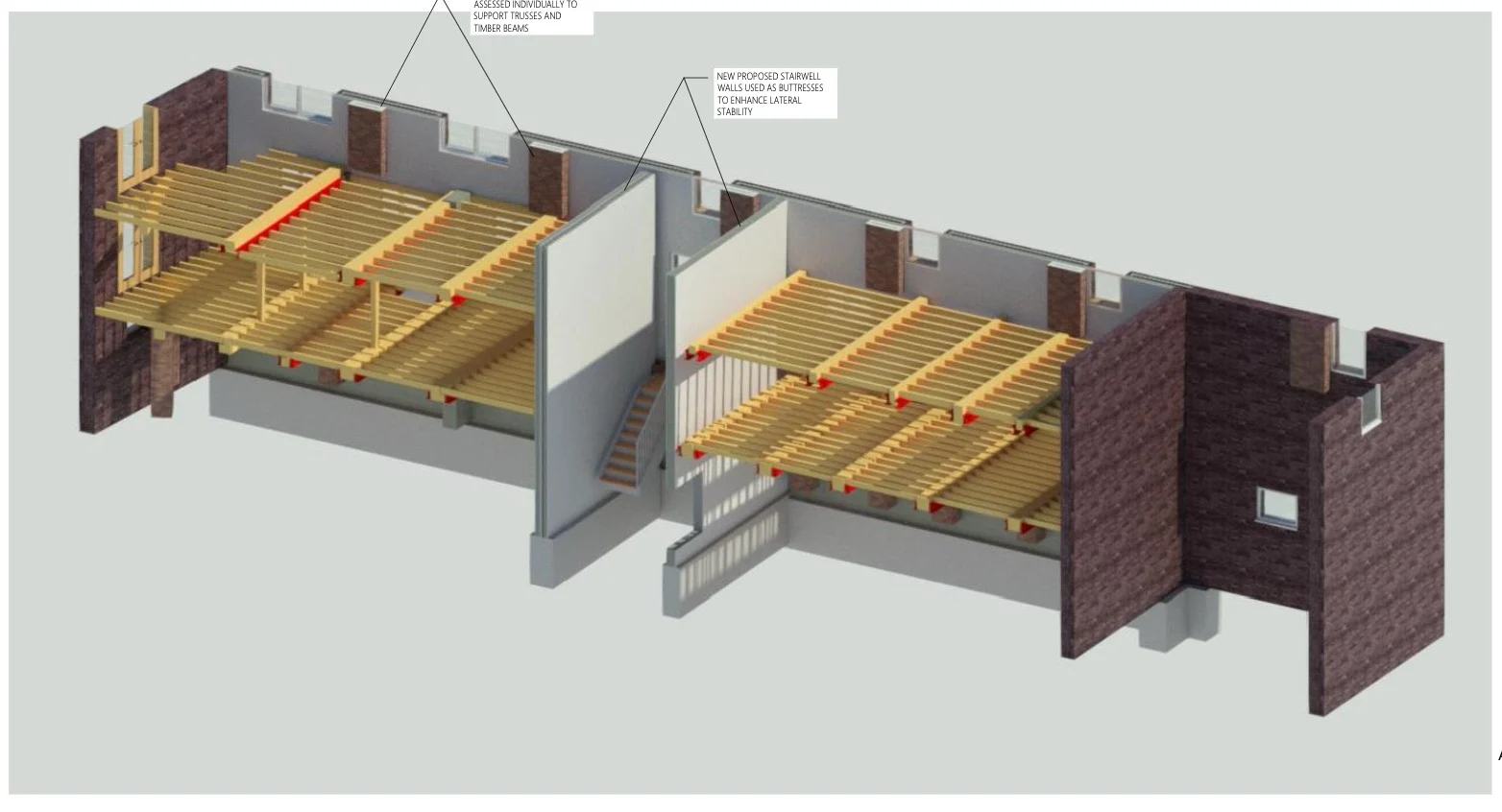
This application focuses on the fabric of the building rather than its final decoration. That distinction is important. The aim is to produce a weatherproof and structurally complete Maltings, not a finished addition to the hotel. Once this phase is finished the building would no longer be at risk, and no longer in the semi derelict state that residents have become used to.
There are several strands to the proposed repairs.
One is the full dismantling and rebuilding of the north west wall. This is the wall that sits directly over Adies Alley and which caused the closure of the passageway. The plan is to take it down in sections, salvage as much of the original brickwork as possible and reconstruct it on a new foundation that reaches firmer soil beneath the made ground. This deeper base should prevent the movement that has plagued the wall for years.
Another strand involves repairing or replacing the timber structure. Many of the joists and beams are too damaged to save. These will be removed and replaced using matching timber. Others can be retained with careful repairs and strengthening plates. Three new internal structural walls are planned to help stabilise the upper floors. A new ground floor slab will also be installed to replace failing sections.

The exterior receives attention too. Poor pointing and cracked render have allowed moisture into the brickwork. These will be repaired using breathable lime based materials. Gutters will be reinstated where they are missing. Bricked up window openings on the upper floors will be reopened and glazed again. The roof, which has already benefited from some earlier work, will receive further small repairs where tiles have slipped or decayed.
Finally, the proposed internal layout is included. This is not the polished hotel fit out but does show where rooms will sit once the building reaches that stage. Upper floors are set aside for hotel accommodation. The ground floor will be arranged so it can host a gym and a small retail unit. This gives the building a clear functional structure from day one of the main repair work, rather than leaving it hollow.
Throughout the process the kiln room is preserved. Only targeted repairs are planned where the brickwork has cracked. The room itself will remain as one of the most historically significant features of the building.
What will the building be like when the work is done
The completed works would produce a building that is safe to enter and weatherproof from top to bottom. It would have repaired walls, solid floors, working drainage and secure foundations. It would also have its full set of windows restored and its original openings brought back to use.
It will not operate as a hotel immediately. That will follow later with a separate interior fit out. However, from the outside and within the stairwells and main rooms, it would look like a rescued structure rather than the abandoned space it has become.
The ongoing impact on Adies Alley
The path will need to remain closed during the dismantling and rebuilding of the flank wall.
The hope is that the long term benefit outweighs the short term difficulty. Once the wall is rebuilt there should be no reason for future emergency closures of the alleyway.
A chance to secure one of Stone’s rare industrial survivors
The Maltings is often described as a building at risk, and the reports supporting this application make clear how close it has come to falling into the same category as other lost industrial buildings in the town. This phase of work gives it the best chance of survival for decades to come.
If approved, the scheme would create a secure and weather tight structure that protects its historic fabric and removes a safety hazard in the town. It also lays the groundwork for the future hotel use that has been talked about for several years.
The plans are now with Stafford Borough Council for consideration.


Related Posts:


4 comments
Shaun Farrelly
If this is to go ahead, it must be funded by the owners and with a guaranteed outcome and timescale. Maybe a maximum of two years, but that is a long time for Adies Alley to be closed.
The real danger is that the owners will default, citing financial restraints, and the town is saddled with an incomplete vanity project. Heritage should be preserved where possible but it must not be taken on by tax payers if it ends up in the lap of the town or borough council. If there is a default, the project will stall and pedestrian footfall along the alley could just be a distant memory by 2030.
Given the parlous state of the Crown Hotel, the omens are not good. Regrettably, the most sensible, economical and swiftest solution may be to demolish it now and the alley could re-open within three months.
Trevor Fletcher
THIS BUILDING AS FAR AS I AM CONCERNED HAS NO ARCHITECTURAL MERIT AND SHOULD BE DEMOLISHED ASAP TO ALLOW THE “PUBLIC RIGHT OF WAY” TO BE RESTORED. WHILST COMMENDABLE THE WORK IS TO EXPENSIVE AND NOT ASTHETICALLY PLEASING.
Sharon Moore-Ward
I am really concerned at the poor quality of building maintenance of The Crown Hotel. Repair work to the car park wall is shoddy. I believe it is the same owners. Can the Council not require them to put that building in good order first before they embark on this?
Alistair Howells
What will happen to the historic machinery within surly that is also listed for heritage reasons