
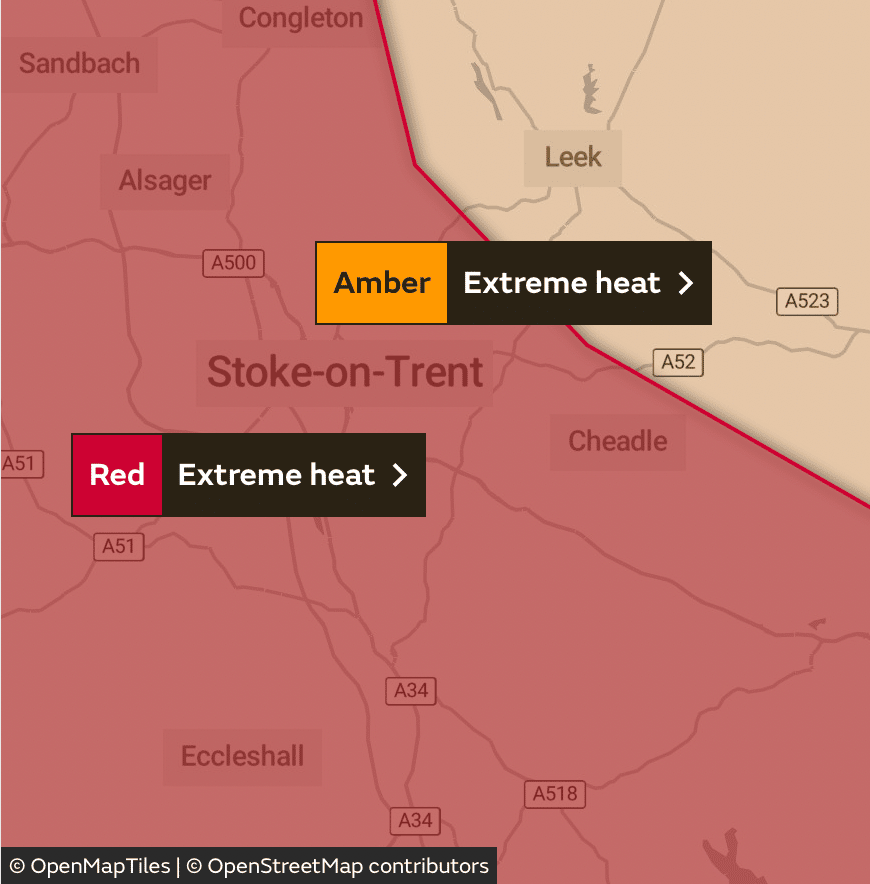
 Stone has been issued with an Extreme Heat ‘Red Alert’ with temperatures forecast to peak at 36° on Tuesday next week.
Yesterday we reported that Stone was on an Amber Alert; however, as the time gets closer and the forecast solidifies this has now been upgraded to a Red Alert.

What does this mean?
This means that we will have an exceptionally hot spell on Monday and Tuesday, leading to widespread impacts on people and infrastructure.
What to expect
- Population-wide adverse health effects experienced, not limited to those most vulnerable to extreme heat, leading to serious illness or danger to life. Government advice is that 999 services should be used in emergencies only; seek advice from 111 if you need non-emergency health advice.
- Substantial changes in working practices and daily routines will be required
- High risk of failure of heat-sensitive systems and equipment, potentially leading to localised loss of power and other essential services, such as water or mobile phone services
- Significantly more people visiting coastal areas, lakes and rivers, leading to an increased risk of water safety incidents
- Delays on roads and road closures, along with delays and cancellations to rail and air travel, with significant welfare issues for those who experience even moderate delays
“Exceptional, perhaps record-breaking, temperatures are likely on Monday, then again on Tuesday. Nights are also likely to be exceptionally warm for the UK, especially in urban areas.This is likely to lead to widespread impacts on people and infrastructure. Temperatures are expected to drop away from Wednesday onwards.”
With the Met Office issuing a ‘Red Warning’ for extreme heat on Monday and Tuesday, ambulance bosses are urging the public not to ignore it and make sure they don’t end up becoming a patient.
The Trust has already seen a rise in the number of heat-related calls to both the 999 and 111 services with calls about sunburn, heat stroke, BBQ burns, dehydration, breathing difficulties and from people enjoying the outdoors who are ill-prepared.
It is vital that people do take on board the warning so that preventable situations don’t end up resulting in people needing to access help from the NHS.
Emergency Services Operations Delivery Director, Nathan Hudson, said:
“Almost everyone enjoys a sunny day, but the difference this time is that temperatures have the potential to reach levels never before seen in the West Midlands.
“Heat can cause some very serious health implications if we don’t treat it with respect, particularly for the very young and elderly, but it can affect people of all ages.
“Dehydration is one of the biggest risks – it happens when you lose more fluid than you take in. We all need to drink enough when it’s hot; water and fruit juices are much better than alcohol, which is a diuretic and will speed up dehydration.
“We already see lots of cases of dehydration in the elderly and the heat will make that worse. Dehydration can lead to breathing problems, confusion, headaches, fatigue, dizziness and may result in patients becoming unsteady on their feet and as a result end up falling which can result in other serious injuries. It can also lead on to heat stroke and a period of being unconscious.
“Dark yellow or strong smelling wee is a good warning sign that you are dehydrated, and you need to act immediately to rehydrate.
“Clearly lots of people want to spend time in our wonderful countryside. If you are going outdoors, please be aware that the sun is at its strongest between 11.00am and 3.00pm. You will need to be prepared with appropriate clothing and footwear, preferably a hat, sunscreen and plenty of water. More positively we have seen a rise in the number of people using What3Words which is helping us to identify where patients who have got into difficulty, are.
It is important to remember that the temperatures given out are measured in the shade, so can be higher still in direct sunlight. If people are out in the sun with no protection, they can get into difficulty quite quickly. We do have cases where people have called us because they have got sunburnt and in extreme cases actually have really nasty burns, which are not only uncomfortable at the time but can result in long term skin damage with the resultant risk from skin cancer too.
“Our main message is enjoy the weather, but do it safely.”
Staffordshire County Council has also issued a reminder to check on elderly relatives, friends and neighbours. A reminder not to cool off by swimming in unsupervised open water or light fires in the countryside has also been issued by the Staffordshire County Council.
[divider style=”solid” top=”20″ bottom=”20″]
Staffordshire County Council’s Cabinet Member for Communities and Culture Victoria Wilson said:
“From Sunday we are going to see very high temperatures until Tuesday and it’s important people stay safe while enjoying the summer sunshine.
“Just by taking a few simple measures people can avoid harm, such as avoiding the sun during the hottest part of the day, staying hydrated and ensuring they apply a high factor sunscreen.
“It’s vitally important people do not swim where there are signs advising against it or in unsupervised open water, even if they’re experienced swimmers. Ignoring this advice can have devastating consequences.
“We’re expecting increased visitor numbers on our country parks over the next few days and are appealing to everyone to be responsible to reduce fire risk by not smoking in high-risk areas, dispose of rubbish properly and remind them that no barbecues are allowed at any time.
“We’d also ask people with more vulnerable relatives, friends or neighbours, just to check they’re ok during this period.”
Pet owners should ensure their animal is kept out of strong sun, as they have a lower tolerance to the heat and are kept cool and hydrated.
Guidance on protection from the sun can be found on the NHS website: www.nhs.uk/live-well