

A large number of streets in Stone are named after people or have historical associations. In the first of a four-part series, Stone Historical Society chairman Philip Leason looks at the origins of the names of many of our town’s streets.
Click for the other three articles:
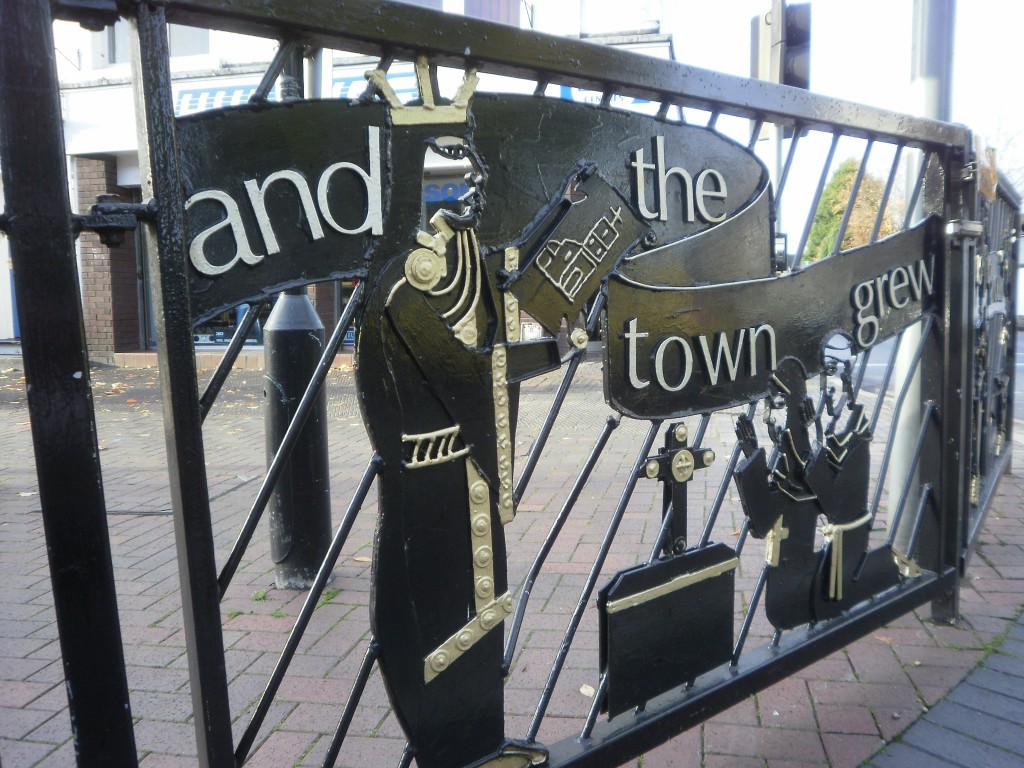
According to legend, Stone owes its origin to the murder of two Saxon Princes, Rufin and Wulfad.
Wulfhere, King of Mercia from 659 to 675 A.D., lived in a fortified hill fort (known as Wulfherecester) at Bury Bank, about two miles from Stone. Like his father Penda, Wulfhere was a pagan, but converted to Christianity on his marriage to Ermenilda, a daughter of the Royal and Christian house of Kent. However he later reverted back to paganism and refused to allow his two sons Wulfad (WULFAD COURT) and Rufin (RUFIN COURT) to be brought up in the Christian faith.
There are various versions telling of how the two Princes were converted to Christianity by St. Chad (ST CHADS CLOSE), one of which tells of how one day while out hunting they followed a white hart which led them to the Saint who was living as a hermit. St. Chad preached to the Princes and later baptised them.
One of the King’s noblemen, Werebode, informed the King that two Princes had defied him and become Christians. The king was so angry at their defiance that he swore he would kill his sons.
The two princes managed to flee but the King rode after them and killed Rufin at Burston and Wulfad here at Stone.
The Queen had their bodies buried together on the spot where Wulfad had fell and in accordance with Saxon custom a large cairn of stones were placed over the grave.
Wulfhere was later overcome with remorse and eventually visited St. Chad to seek absolution and in about 670 A.D. allowed the Queen to build a small priory on the site of the Princes grave. Around which a small village began to grow which was known as Stanes/Staines (STAINES COURT) (Anglo-Saxon for stones) after the cairn of stones and over the centuries the name became Stone.
Out of interest Rufin and Wulfad are depicted in the two of the windows in St. Michael and St. Wulfad’s Church, there is an altar dedicated to the Stone Martyrs in St. Dominic’s Roman Catholic Church and an interpretation of the legend is depicted on the railings in Granville Square (pictured above).
The priory founded by Ermenilda flourished until the 9th century when it was largely destroyed by invading Danes. It is believed that with the priory destroyed the few canons and nuns went to live on the Priory Farm at Walton. The farm was located in the area where the shops (Walker’s Butchers, The Co-Op etc) are today. Part of the building was referred to as the “Priors Hall” and was where in the 18th century early non-conformist services were held.

In the Domesday Book of 1086 it mentions a priest living at Walton. The name of WALTON PRIORY MIDDLE SCHOOL and FRIARS AVENUE and CANNON DRIVE remind us of this part of our history.
In the Norman period Ernald (ERNALD GARDENS) held the manor of Walton from Robert de Stafford.
In 1130 Geoffrey de Clinton (CLINTON GARDENS) purchased the advowson of Stone Priory and granted it to the Priory of Kenilworth.
Further purchases of land made the priory at Stone so important that by the 13th century it was independent of Kenilworth.
The cannons at the priory were of the Augustinian order or sometimes referred to as Austins (AUSTIN CLOSE).
The priory occupied a large portion of the land at the lower end of the High Street, around there area where St. Michael and Wulfad’s church and churchyard are today. The Street boarding the priory would have been ABBEY STREET.
LICHFIELD STREET was only constructed in 1770 and on old maps is often referred to as New Road.
When a new estate was built by the former Stone Urban District Council it was envisaged that the main road on the estate would link up with Abbey Street and it was therefore appropriate to name it PRIORY ROAD.
The Stone Priory was included in the first phase of Henry VIII’s Dissolution of the Monasteries and closed in 1537 when its buildings and land were sold off.
Among those purchasing land and property was William Crompton (CROMPTON ROAD). The Crompton family lived at Stone Park. In 1660 it is recorded that Stone Park was “well wooded and stocked with deer” and had two lodges – one in the town Park Lodge and one on the Uttoxeter Road (Aston Lodge).
The old Priory Church that had continued to be used for public worship collapsed in 1749 and was replaced by the present St. Michael and St. Wulfad’s Church and around it was built around its grounds – CHURCH STREET.
Just off Church Street is an area of land called THE HEMPBUTTS. There was an old statute which required men to practice their archery on a Sunday in order that they were prepared for war when required. Infact in some old churches you can still see where they sharpened their arrow heads on the doorways. It is thought that the butts were where the Stone men practiced, next to a marsh where hemp was grown. Hemp is a very fibrous plant and was used for various products including making rope.
We will continue our look at the origin of Street names in next months “History Monthly” – I hope that you have found it of interest.
Philip Leason
Chairman, Stone Historical Society
Here’s a teaser – do you know why Adie’s Alley is so called? I’ll put the answer here in a couple of days!





6 comments
Judy Schnell (nee Musgrave)
Found this site by accident ,I lived in Stone for 30 years up to 20 years ago, and still think of it as home. I enjoyed your article; of course I know the origins of Adie’s Alley!
Anne Trinder
Thanks very interesting.
Ella
Really interesting! Thank you!
John Mills
Most informative. Thank you. I look forward to reading more.
Dennis A
Very Interesting. Thank you Philip