
 Today the UK Government has published its full guidance on wearing facemasks as the country continues to tackle the Covid-19 pandemic. If you’re heading into Stone read what you need to do to comply.
From tomorrow, 24th July, you can be issued with fixed penalty notices of £100, discounted to £50 for failure to comply with The Health Protection (Coronavirus, Wearing of Face Coverings in a Relevant Place) (England) Regulations 2020
Our article will focus on the rules in England however we’ve included links to the rules for Wales, Scotland and Northern Ireland.
Unless exempt, in England, you must wear a face-covering by law in the following settings:
- on public transport
- indoor transport hubs such as airports, rail, sea, bus and tram stations and terminals.
- shops and supermarkets (places which are open to the public and that wholly or mainly offer goods or services for retail sale or hire)
- indoor shopping centres
- banks, building societies, and post offices (including credit unions, short-term loan providers, savings clubs and money service businesses)
You are expected to wear a face-covering immediately before entering any of these settings and must keep it on until you leave.
You are also strongly encouraged to wear a face-covering in other enclosed public spaces where social distancing may be difficult and where you come into contact with people you do not normally meet.
You are also to assume that wearing a face-covering is standard when visiting a hospital, GP, care home or other primary or community healthcare setting, but be prepared to accept those individual settings may have their own policies and require you to take other measures.
Where this law does not apply
Indoor premises that sell goods or services but are not typically defined as a shop. Examples of this are restaurants with table service, bars, pubs, entertainment venues (such as cinemas or casinos), visitor attractions (such as heritage sites or museums), exercise and sports venues (such as gyms), and places that provide medical treatment (such as a dentist or optician).
Where a shop is within another premises which does not require a face covering (such as a museum or other visitor attraction) masks are required in the shop only. Check for signage upon entry and exit to know when this is the case.
When you can remove a face covering
You can remove your face covering in order to eat and drink if reasonably necessary. This should be in an area that is specifically for the purposes of eating and drinking, such as a food court, unless no such area is available.
If a shop or supermarket has a café or seating area for you to eat and drink, then you can remove your face-covering in this area only. You must put a face-covering back on once you leave your seating area. If you are in a cafe or takeaway restaurant that does not provide table service, you must wear a face-covering unless you are in a designated seated area.
Enforcement measures for failing to comply with this law
Measures can be taken if people do not comply with this law without a valid exemption.
Shops, supermarkets and other premises where face coverings are required are encouraged to take reasonable steps to promote compliance with the law and could refuse entry to anyone who does not have a valid exemption.
Transport operators can deny access to their public transport services if a passenger is not wearing a face covering, or direct them to wear one or leave a service if they are not wearing a face covering.
If necessary, the police and Transport for London (TfL) officers have enforcement powers including issuing fines of £100 (halving to £50 if paid within 14 days).
When you do not need to wear a face-covering
In settings where face coverings are required in England, there are some circumstances, for health, age or equality reasons, where people are not expected to wear face coverings. Please be mindful and respectful of such circumstances, noting that some people are less able to wear face coverings and that the reasons for this may not be visible to others.
It is not compulsory for shop or supermarket staff or transport workers to wear face coverings although employers may consider their use where appropriate and where other mitigations are not in place. Employers should continue to follow COVID-19 Secure guidelines to reduce the proximity and duration of contact between employees.
You do not need to wear a face-covering if you have a legitimate reason not to. This includes (but is not limited to):
- young children under the age of 11 (Public Health England do not recommend face coverings for children under the age of 3 for health and safety reasons)
- not being able to put on, wear or remove a face covering because of a physical or mental illness or impairment, or disability
- if putting on, wearing or removing a face covering will cause you severe distress
- if you are travelling with or providing assistance to someone who relies on lip-reading to communicate
- to avoid harm or injury, or the risk of harm or injury, to yourself or others
- to avoid injury, or to escape a risk of harm, and you do not have a face-covering with you
- to eat or drink if reasonably necessary
- in order to take medication
- if a police officer or other official requests you remove your face covering
There are also scenarios when you are permitted to remove a face covering when asked:

- if asked to do so in a bank, building society, or post office for identification
- if asked to do so by shop staff or relevant employees for identification, the purpose of assessing health recommendations, such as a pharmacist, or for age identification purposes including when buying age-restricted products such as alcohol
- if speaking with people who rely on lip reading, facial expressions and clear sound. Some may ask you, either verbally or in writing, to remove a covering to help with communication
Exemption Cards
Some people may feel more comfortable showing something that says they do not have to wear a face covering.This could be in the form of an exemption card, badge or even a home-made sign.
This is a personal choice and is not necessary in law.
Those who have an age, health or disability reason for not wearing a face mask should not be routinely asked to give any written evidence of this. Written evidence includes exemption cards.
Access exemption card templates
For exemptions in different parts of the UK please refer to the specific guidance for Northern Ireland, Scotland and Wales.
How to wear a face-covering
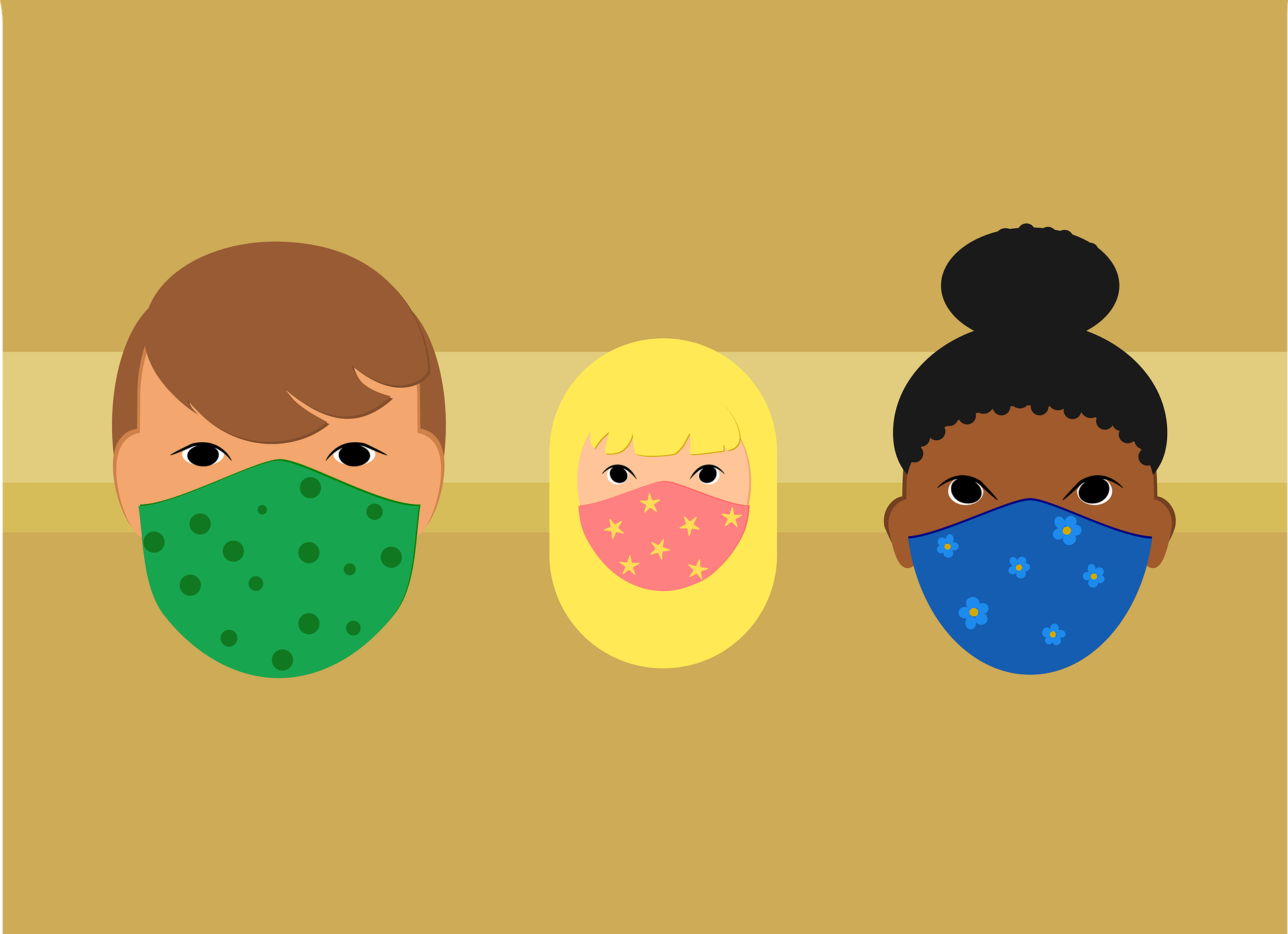
A face covering should:
- cover your nose and mouth while allowing you to breathe comfortably
- fit comfortably but securely against the side of the face
- be secured to the head with ties or ear loops
- be made of a material that you find to be comfortable and breathable, such as cotton
- ideally include at least two layers of fabric (the World Health Organisation recommends three depending on the fabric used)
- unless disposable, it should be able to be washed with other items of laundry according to fabric washing instructions and dried without causing the face-covering to be damaged
When wearing a face covering you should:
- wash your hands thoroughly with soap and water for 20 seconds or use hand sanitiser before putting a face covering on
- avoid wearing on your neck or forehead
- avoid touching the part of the face-covering in contact with your mouth and nose, as it could be contaminated with the virus
- change the face-covering if it becomes damp or if you’ve touched it
- avoid taking it off and putting it back on a lot in quick succession (for example, when leaving and entering shops on a high street)
When removing a face-covering:
- wash your hands thoroughly with soap and water for 20 seconds or use hand sanitiser before removing
- only handle the straps, ties or clips
- do not give it to someone else to use
- if single-use, dispose of it carefully in a residual waste bin and do not recycle
- if reusable, wash it in line with manufacturer’s instructions at the highest temperature appropriate for the fabric
- wash your hands thoroughly with soap and water for 20 seconds or use hand sanitiser once removed
Face coverings at work
Please see section 6 on the Governments guidance to face coverings. – Click Here
Making your own face covering
If you want to make your own face covering, instructions are widely available online.
Emerging evidence suggests that the risk of transmission may be reduced by using thicker fabrics or multiple layers. However, the face-covering should still be breathable.
Children should make face coverings under the supervision of an adult and face coverings for children should be secured to the head using ear loops only.
If you would like more information on how to make a face-covering with materials from around your home please visit the Big Community Sew website. Here you will find step-by-step video tutorials on how to make face coverings and other useful tips and advice.
Maintaining and disposing of face coverings
Do not touch the front of the face-covering or the part of the face-covering that has been in contact with your mouth and nose.
Once removed, store reusable face coverings in a plastic bag until you have an opportunity to wash them. If the face covering is single-use, dispose of it in a residual waste bin. Do not put them in a recycling bin.
Make sure you clean any surfaces the face-covering has touched using normal household cleaning products. If eating in a restaurant, for example, it is important that you do not place the face-covering on the table.
Wash your face covering regularly and follow the washing instructions for the fabric. You can use your normal detergent. You can wash and dry it with your other laundry. You must throw away your face covering if it is damaged.
The government has also published guidance on the safe disposal of waste for the public and businesses.
[box type=”info” align=”alignleft” class=”” width=””]The full Government Guidance can be found at – Click Here[/box]