

Today we are all too sadly aware of fatalities as a result of road accidents, writes Stone Historical Society chairman Philip Leason. In 1799 there was a fatal accident near Tittensor when a coach overturned and fell into the flooded River Trent. One of the victims was a former under-treasurer to the Prince of Wales. The old road ran nearer to the river than the present A34 does today.
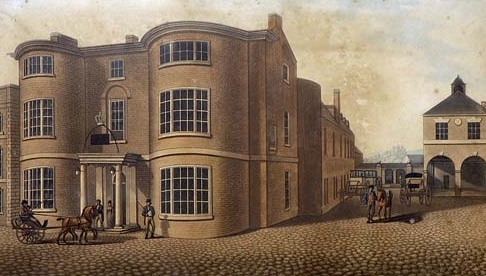
The two following extracts are from the “Gentleman’s Magazine” of October and November 1799 and give details of the accident.
The “Gentleman’s Magazine” was founded by Edward Cole (1691-1754) in January 1731. It is worth noting that Samuel Johnson’s first regular job was writing for the magazine. The publication ceased to be produced in 1907.
October 1799
Obituary of remarkable Persons: with Biographical Anecdotes
Of all the deplorable cases which too frequently happen by the carelessness of stagecoach drivers, the loss of Arthur Robinson esq. of Duke Street, St. James,* his wife and their female servant, returning this day from a six weeks tour on a visit to their friends, in the balloon coach from Liverpool to Birmingham, is the most truly afflicting.
The Trent having been unusually swelled by the late incessant rains, the coach was unfortunately overturned as it was passing it at Tittensor. There were six inside and three outside passengers, besides two coachmen, the regular driver being ill on the roof, when the coach fell; and his having been obliged to trust the reins to another is supposed to have been the principal cause of the melancholy event. The other passengers, consisting of two naval officers and a respectable gentleman of Liverpool, extricated themselves, and were fortunately saved, though with great difficulty; and those on the outside fortunately escaped.
The body of Mrs Robinson was taken out of the coach about a quarter of an hour after the accident, that of the servant was found soon after; but the remains of Mr. Robinson were not discovered till the following evening, having floated down with the torrent. Their persons were identified by the inscription on the collar of a favourite spaniel that accompanied them.
On the 11th a coroner’s inquest was held before J Dickenson, gent., of Stafford: but the witnesses examined were scarcely recovered from the shock occasioned by the accident, and were not able to give any circumstantial detail of it. Accidental Death. There never was a more humane, more friendly, or upright man existing; or a more worthy benevolent women. Mr Robinson’s employment were in the services of the first personages in the Kingdom: and he executed them with that fidelity, promptitude, and exactness, which gained him the approbation of all, and even their confidence.
He was for many years in the Prince of Wales family, as one of his gentlemen ushers and under-treasurer, and was likewise under-treasurer to the Dukes of York and Clarence, and the younger princes. When the prince’s establishment broke up, his Royal Highness, as a mark of his esteem, settled a pension of £500 on him, which he enjoyed till his death.”

November, 1799
Death of Arthur Robinson, Esq., 8th October 1799
The melancholy accident which befell Mr. Robinson and his wife and servant near Stone in Staffordshire was occasioned by the obstinacy of the man entrusted to drive the coach who is horse keeper at the inn at Stone. The coachman was ill on the road and one of the passengers, (who were Mr. and Mrs Robinson, their servant, a sailor, two gentlemen), observing that the coach was drawn too close to the railing on the side of the river, which runs parallel with the road, spoke to the driver to keep farther off, and on the wheel touching one of the posts he was sharply remonstrated with, but he replied there was no more danger than on a floor.
In about a minute after, the edge of the bank gave way under the fore wheel, and the coach, horses and passengers fell instantly over into the river. The sailor was the first who extricated himself from the middle of the coach, and indeed was the only person who seemed to have the least presence of mind or activity. After having assisted the two gentlemen to get out of the coach, he with much difficulty got Mr. Robinson out; but perceiving Mrs. Robinson and the maid in great extremity he quitted Mr. Robinson who unfortunately was not able to get on shore being carried down by the strength of the stream. And it was three days before his body was found.
On the sailor swimming to the coach again he got hold of Mrs. Robinson’s maid, but after every exertion he was unable to release her, as the old lady clung so fast to her that he was obliged to quit them, being nearly exhausted and with some difficulty reached the shore.
In a few minutes after he perceived the young women had extricated herself from the coach and was floating down the steam calling to the other persons to assist her. Which determined him to make another effort to release Mrs Robinson as he doubted not the rest could save the young women which they certainly might have done had they but fortunately had sufficient presence of mind to have held out a stick to her, as she was found in about half-an-hour afterwards hanging by a branch of a willow which she caught her hand, but was then quite dead.
The humane and courageous sailor succeeded in bringing the unfortunate Mrs. Robinson on shore and conveying to the nearest cottage, where, had the means recommended by the Humane Society been immediately resorted to she might probably have been saved as her body was not cold. The melancholy accident happened between 7 and 8 o’clock in the morning.”
In another account of the accident the sailor is reported as saying that “he had been nearer to drowning at Tittensor, near Stone, than on any of the oceans of the world”.
This incident gives another insight into the dangers of travelling by coach during the period and shows that road accidents are nothing new.
* The publishing offices of the “The Gentleman’s Magazine were in St. James’s and so it is possible that the then editor knew the Robinson’s