

“Sparked” by the article on the replacement fire station featured on “A Little Bit of Stone” recently I thought this month we would look at the history of firefighting in Stone, writes Philip Leason.

The origins stem back to the Parish Engine, dated 1787, which was kept on the porch of St. Michael’s Church. In addition insurance companies maintained their own firefighting force for the benefit of their policy holders. For example the Birmingham Insurance Company had an engine housed in a shed near to the site where the church hall is today in Lichfield Street. Policy holders displayed a “fire mark” on their property and when there was a fire the company engine turned out and – only if insured by them – they would stop and put out the fire.
The Parish Brigade and the Volunteer Brigade amalgamated to form Stone Volunteer Fire Brigade. At first they were equipped with a “Defiance Engine” but in 1882 after a public subscription a “Sutherland Manual Engine” was purchased.
In 1886 Brigade were supplied with a new horse-drawn steamer engine purchased with the proceeds of a bazaar. It was named Edith Mabel after the youngest daughter of Mr (later Colonel) Harding, who was in charge of the brigade at that time.
The fire station at this time was located in Crown Street, in premises which are today the car accessories shop. Before the engine could be turned out the horses had to been collected from Crown Meadow and the boiler of the steamer had to be lit. The firemen were alerted of a fire by the ringing of a bell in a turret at the fire station. This bell had this inscription: “Come away make no delay.”
A report in the “Staffordshire Advertiser” on 5th October, 1889 describes the brigade as: “Efficient as anyone could wish and the fire station would bear comparison with anything within fifty miles of Stone.”
The Stone Brigade were talking part in drill and efficiency competitions and in 1889 having won a national competition in Brighton the team were met at Stone Railway Station by the band of the Staffordshire Rifle Corps who led them through the town playing the tune “See the Conquering Hero Comes” and the traders of the town provided them with an impromptu banquet. In 1890 a station team under the command of Captain Smallwood were taking part in drill competitions is such places as far away as Dublin and Paris.
There was always a great rivalry in the competitions between the Stafford and Stone brigades. In 1888 a competition for steam fire engines was held as part of a fete and gala at Swynnerton Park. There had been heavy rain and the ground was a quagmire and the Stafford team felt that it was unsuitable to drag heavy fire engines over the land and withdrew. However the Stone team arrived, dismounted and with the help of three horses, carried out the drill and were awarded the prize.
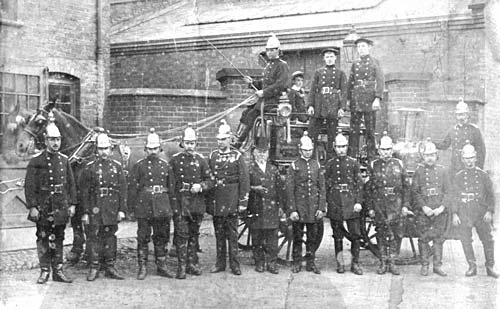
As well as being efficient the firemen were loyal for a number of long service medals were awarded, many for 20 and 25 years service.
In 1904 the Fire Brigade came under the control of the Stone Fire Engine Joint Committee, part of the Urban District Council.
The first motor fire engine was acquired in 1924 and was supplied by Merryweather & Sons, of London.

The next important development of the brigade was the move from Crown Street to a new fire station in Newcastle Street. The transfer took place on 22nd January, 1932. The appliances then consisted of a Merryweather Pump and a Ford Van. Two houses were demolished to make way for the new station. The builder was H. Fairbanks of Oulton and the accepted tender was for £888.
During the Second World War the station was manned by full-time men and sub-stations with trailer pumps were established at Meir Heath, Barlaston, Sandon and Stone. During the early years of the war these trailers were often towed behind private cars. In November 1940 a team from Stone Fire Station were sent to Coventry to assist when the city was destroyed by bombing.
Throughout this period the history of the fire service in Stone was strongly connected with the Smallwood family. As stated earlier William Smallwood was Captain of the brigade in the late 1890s. He was succeeded on his death by his son, Samuel Smallwood, who remained in charge until 1945. The Second Officer and Secretary of the Stone Fire Engine Committee was Jim Smallwood and other members of the family also served in the brigade.
In November 1941 the National Fire Service came into being and the control of the fire brigade passed from the local authority to the Government. Promises were made that at the end of the emergency the service would revert back to the local authority’s control, but when the change took place in 1948 it was the County Council rather than the Urban Council which became the Fire Authority. Thus Stone Fire Brigade became part of Staffordshire Fire Service.
Today the firefighters are notified of a fire by pocket alerters but in the past a siren (located on the top of the old Co-Op building in Radford Street) was sounded and at night a bell rung in the homes of the firemen.
In 1975 the Fire Station moved to the present premises at Walton and was officially opened by County Councillor T. E. Cowlishaw on Wednesday 6th August. The main contractors for the building were Banks and Bennett Limited of Stone and the contract sum for the building of the station and for two houses for fire service personnel was £130,129.
The need for the new station was explained as follows: “Present day requirements dictated the necessary for a new fire station, whilst the Newcastle Street station has well served its purpose, the new fire station will be able, more adequately to cope with current conditions. There has been a gradual upsurge in the number of calls dealt with each year. For instance, the average number of calls in the years 1965 to 1967 was 76 a year. In the last three years (1972-1974) it has been 141 a year – an increase of about 85% in a period of less than 10 years.”
In 1996 Staffordshire Fire Brigade became known as Staffordshire Fire and Rescue Service under the “The Staffordshire Fire Service (Combination scheme) Order.”
In 2000 the fire station celebrated its Silver Jubilee with an open day on 5th August.
The new fire station which is planned and information on which featured recently on “A Little Bit of Stone” here will carry on the great tradition of firefighting in the town well into the 21st century and will be another chapter in “The History of Firefighting in Stone.”