This month, to coincide with the final service being held on Sunday before the congregation move out to make way for its sale, Stone Historical Society chairman Philip Leason takes a look at the history of St John’s Church. He describes how the church was gutted by fire in 1886 – and how a time capsule was buried beneath it when it was built…
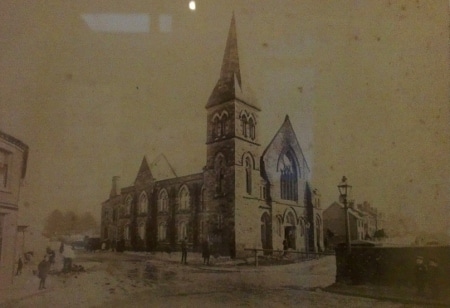
An image of St John’s from the late 1870s
Originally known as the Congregational Church, it replaced the old Independent Chapel.
The original Independent Chapel was located in Chapel Street (later North Street and later still Station Road) on the site where St. Mary’s Chambers are today. In 1869 the old chapel was in need of repair (including replacing the roof) and so it was decided to build a new church.
The Staffordshire Advertiser for 10th September 1870 records the laying of the foundation stone. I do not normally give a full quote from my primary source but feel that as St John’s is in urgent need of repair at great expense if ever the building is demolished this account gives a good description of the building. In addition, if it is sadly demolished it will remind those involved that there is a cavity below the foundation stone containing historical items of interest…
“During the last few years we have had occasion to notice many important improvements in the town of Stone – notably the erection of a commodious market and town hall, and this week we are called upon to record the laying of the foundation stone of a building which will prove no mean addition to the street architecture of the place.
“The Congregational body at Stone have long found the building in which they now worship inadequate and unsuitable to their requirements, and soon after the Rev. J. P. Bake, B.A., their present pastor, began his labours among them, it was determined to build a new Chapel. The movement, once set on foot, was vigorously carried forward, and the Congregationalists of Stone and other towns in the county, and at a distance, came forward with liberal promises of subscriptions.
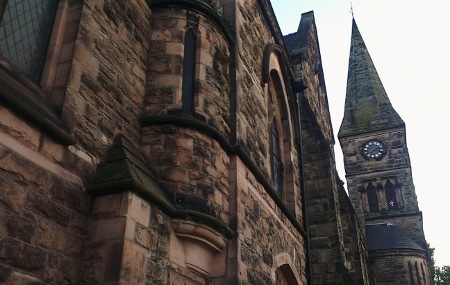
The outside of the church today. Reports when it was built said its Geometric Gothic style would be a real boost to the street architecture of Stone
“Several members of the Established Church, including Mr. Thomas Bostock and Mr. Meakin, and of other religious bodies rendered assistance. Towards the sum of £3,500 which is estimated will be required, £2,100, including the value of the old property, had been secured before the interesting proceedings of Tuesday, and the result of that day’s effort was to reduce the sum still required to about £1,300.
“The new church is to be erected on a very eligible site in Granville Place, generously given by Mr. Thomas Bostock. The style will be Geometric Gothic. The wall will be brick faced, having some stone dressings. The centre of the west or principal front will be gabled, and over the entrance doorway will be a large five-light tracery beaded window. At the south west angle will be a tower, with spire rising to the height of 80 feet, and the north side of the west front an octagon staircase wing.
“The north and south fronts will be divided by buttresses into bays, with two tiers of windows, the lower lighting the ground floor, the upper lighting the gallery of the church. The dimensions of the church will be 65 feet by 38 feet and including the galleries it will seat about 700 worshippers. Internally, the roof will be in part open, showing the timber framing as far as the collar beam. At the rear of the Church, but having a south frontage to the Longton Road, will be school buildings, two storeys in height, the lower storey arranged for vestries, class rooms and infant school, and the upper storey a large schoolroom 44 feet by 27 feet.
“The architect is Mr Bidlake of Wolverhampton, and during the next week tenders will be received from builders now estimating, and the work will be vigorously prosecuted. The builder who executed the work necessary for the laying of the foundation stone was Mr. R. Turner of Stone and Mr. Wood prepared and engraved the stone, which bore the following inscription:-
“This stone was laid by John Crossley, Esq., J.P., of Halifax, September 6th 1870. The site was given by Thomas Bostock, Esq.”
“Mr Blake read a statement and added “that in the bottle deposited in the cavity under the stone, were copies of the ‘English Independent’, the ‘Daily News,’ the ‘Staffordshire Advertiser,’ the ‘Staffordshire Sentinel’ and the statement he had read.”
You may be wondering as to the reference to the building being “brick faced, having stone dressings.” In April 1871 it is reported that “after the contact was taken the committee decided to have the exterior of the building formed of stone instead of brick. The dressing will therefore be of Hollington stone, and the rock face work from Grinsill quarries, near Shrewsbury. We think the committee are entitled to the thanks of the public for deciding upon the change, which, although involving additional expense, will add greatly to the appearance of a building which promise to be a very great ornament to the town.”
The next stage in the history of the church is taken from The Staffordshire Advertiser of 18th November, 1871. “Fourteen months since we recorded the laying of the memorial stone of a new Congregational Chapel and Schools at Stone. The good work then happily begun has since been carried to a successful issue, and Monday last witnessed the opening of the new Church and Schools.”
Although open for worship it was several more years before the final money was raised to pay for it.
All was going well with the church until 1886 when disaster struck, as this account from the ‘Staffordshire Chronicle’ of 20th March 1886 records (I have quoted again in full as it shows the desperate attempts that were made to save the building and problems faced by the fire service in the past).
“Christians of all denominations will not fail to sympathise with the Congregationalist at Stone in the unhappy loss last Sunday morning of their church and schools by fire. About half past two o’clock on Sunday morning P.C. Starkey, on duty, left the Pump Square to go up Radford Street in the direction of the Congregational Church. Going up the hill he became conscious of a small light in the neighbourhood of the Congregational Church, and was at first under the impression that a lamp had been inadvertently left unextinguished.
“He went to see, and on arriving at the building, found the light, whatever it was, came from the minister’s vestry within. He was confident that all could not be right, and accordingly he went to the residence of the chapel-keeper, John Summerfield, close by. He awakened the official, and the two together returned to the chapel.
“By the time they arrived a serious state of things became evident. The fire had gained hold in the minister’s vestry, and when they opened the schoolroom door and endeavoured to make their way to the vestry, they were stopped by a dense volume of smoke. At first they hoped they might extinguish the fire with water from the school well, but examination proved that the water was frozen, and therefore, that idea was impracticable. At once they hastened away in different directions about the town to summon the fire brigade and other nearby interested in the building.
“Mr John Harding, the captain of the brigade and Lieut. W. C. Stubbs were quickly on the alert, but it was some little while before the fire engine could be got from the rather awkwardly situated station in Crown Street to the scene of the conflagration. Meanwhile, Superintendent Harrison and several constables turned out to render assistance and other who came up were Mr M. R. Turner, the secretary of the Sunday Schools, who was pretty well first on the spot, Mr W Whitfield, of Northesk Street, Rev. W. Nicholson, Mr W B Woolley, etc.
“On the arrival of the first comers it was found that the flames had already made their way through the ceiling of the minster’s vestry, and were attacking the organ. Once this valuable instrument was alight, it burnt like matchwood and the flames leaped up fiercely and caught hold of the roof. The schools also caught above, and a gentle north breeze spread the fire with much rapidity through the church, where the pitchpine fittings offered an easy prey. An attempt was made by Mr Whitfield, who is a deacon of the church, to work within the building, but he and others were quickly driven back by the intensity of the heat and the suffocation smoke. It soon became evident that it was impossible to think of saving anything within the Church and Capt. Harding wisely determined to devote all the energies of his brigade to protecting as far as possible the schools and the tower.
“But everything was against them. There was no stream within anything like ‘tapping’ distance, and the water in the outdoor pumps in the neighbourhood, on which the brigade were, perforce, obliged to rely, was for the most part congealed by frost, the intensity of which has not be surpassed for many years. The water even froze in the engine which it was being pumped, and formed icicles on the outer portions of the building while the inner part blazed furiously. The firemen worked with all the energy they were capable of, assisted by the pastor, the Rev. W. Nicholson, Mr Whitfield, Mr Woolley and others.
“From three to four o’clock the scene was one of wild excitement. It was after four o’clock that the roof of the church fell in. The efforts of the firemen were more successful in the schools, which were not completely gutted as the church, and some of the property was saved, including the school library; two harmoniums, one belonging to the Good Templars Lodge, were however destroyed. The flames were git under control by five o’clock, although the firemen were hard at work for a considerable time longer. When an entrance was made to the church, only the four walls were standing. Galleries, flooring, roofing, and all the keys of the organ had utterly disappeared. Externally, the walls looked fairly sound, but examination showed that the end gables were out of the perpendicular and that the side walls were a good deal damaged inside.”
On investigation it was discovered that the fire had started as result of a beam in the ministry’s vestry had been built into the flue from the heating apparatus below.
Article continues after this message
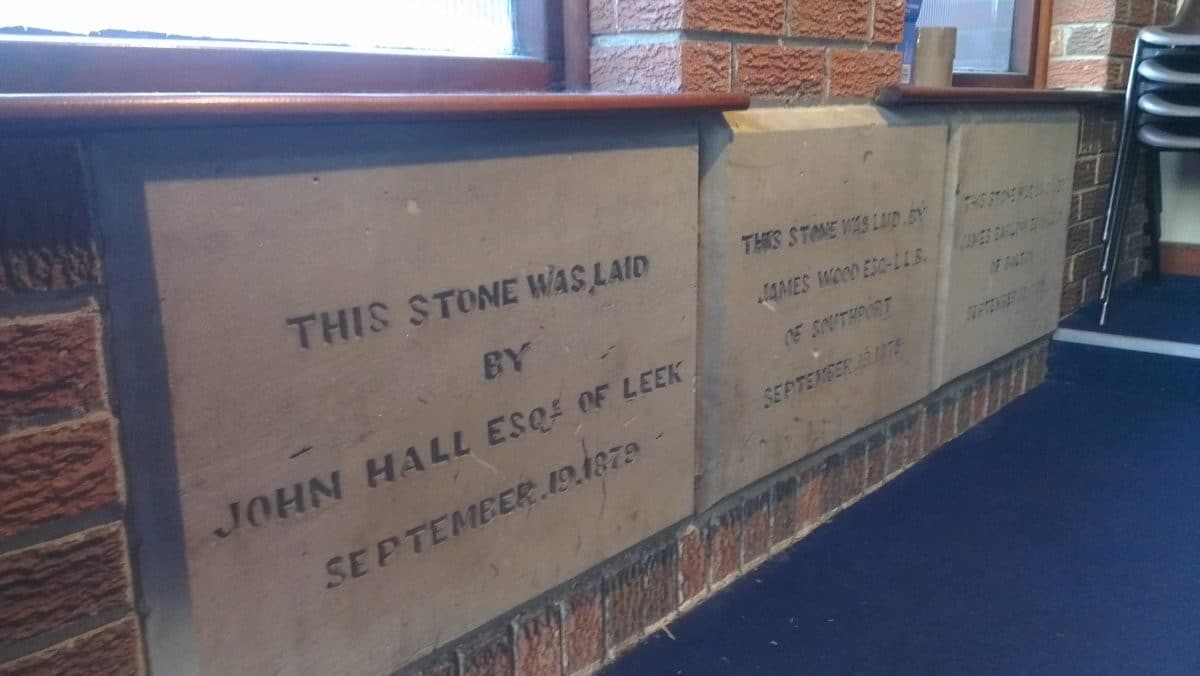
Foundation stones in the church from the late 19th century
A meeting was held on the Monday evening after the fire and it was decided to rebuild the church and in the meantime to use the Town Hall for services. At a public meeting held later in the week in the Wesleyan Chapel (which was located in The Avenue) £300 was raised towards the rebuilding. The congregation took the opportunity to make a few changes and improvements to the new building and the opening service was held on 27th January 1887.
Various associations were formed by the church:
In 1879 a Mother’s Meeting had started and carried on with the move to the new church. Sunday Schools for children were held both in the morning and afternoons each week. A Men’s Bible reading group was started on a Sunday afternoon and it was attended by as many as 70. The church even had its own football team
In 1919 the Rev. Arthur Haig started the Girl Guides and the 1st Stone Guides is one of the oldest Guide units still in existence in the county
In 1925 Mr Arthur Mayer founded the 14th Company of the North Staffordshire Battalion of Boys’ Brigade and later a Life Boy Team. The unit was disbanded in 1957
In 1961 the Rev Gwilym Williams held a Sportsmen’s Service and got together a male voice choir as part of it. Members enjoyed singing together so much that they went on to form the Stonefield Singers (now known as Stone Male Voice Choir).
Returning to the church and in 1935 the gas lighting was replaced with electricity and this also resulted in the organ no longer having to be pumped by hand.
In the early 1950s it was discovered that there was dry rot in the school building and the roof of the Guild room was found to be unsafe, so the church and the vestry were the only buildings that could be used. Eventually the school building was demolished and in 1960 a new church hall opened.
In 1970 major alterations were undertaken to the entrance of the church including making two classrooms for the Junior Church.
In 1975 the Stone Methodist Church and the United Reformed Church (formerly the Congregationalists) started talks towards forming a United Free Church by merging the two churches. On Sunday 23rd January, 1977 a special service was held to mark the uniting of the two churches and the renaming the church St. John’s.
The former Methodist Church was later sold and demolished for housing.
Perhaps due to its location right by a busy road and yards away from a railway line, over the years the church has always been in need of restoration work. In 1992 for example it launched an appeal to undertaken work on the spire and the roof for a total of £85,000.
In recent years there has been a problem with the church hall which has rendered it out of use. A recent report shows that £1.75 million needs to be spent on the church to make it safe for use, a sum the congregation cannot afford and as reported on “A Little Bit of Stone” it has been decided to sell the building, so beginning another chapter in the history of the Methodist and United Reform Church in the town.
Dear Members of Stone Historical Society,
I’m writing to ask if anyone can tell me about my ancestors who were Congregationalist Ministers in your area.
My grandfather John Bevan, a Congregationalist Minister born 20.10.1877, is said to have had his first pastorate at Stone from 1907 to 1911. Would this have been in this church? His daughter my mother Celia Bevan was born in Stone on 18.11.1910, her father’s address at that time was:
John Bevan ,The Manse, Chanville? /Granville? Terrace, (not very legible), Stone
John Bevan’s wife was Frances Margaret Bennett born 24.01.1883 in Stoke on Trent, her father Henry Edward Bennett ( born 1851) was also a Congregational Minister, but I do not know where he was Minister. Possibly also at Stone?
Do any of these names mean anything to you? I’d love to find out more!
Diana
This website uses cookies to improve your experience. We'll assume you're ok with this, but you can opt-out if you wish. Cookie settingsACCEPTREJECT
Privacy & Cookies Policy
Privacy Overview
This website uses cookies to improve your experience while you navigate through the website. Out of these cookies, the cookies that are categorized as necessary are stored on your browser as they are essential for the working of basic functionalities of the website. We also use third-party cookies that help us analyze and understand how you use this website. These cookies will be stored in your browser only with your consent. You also have the option to opt-out of these cookies. But opting out of some of these cookies may have an effect on your browsing experience.
Necessary cookies are absolutely essential for the website to function properly. This category only includes cookies that ensures basic functionalities and security features of the website. These cookies do not store any personal information.
Functional cookies help to perform certain functionalities like sharing the content of the website on social media platforms, collect feedbacks, and other third-party features.
Performance cookies are used to understand and analyze the key performance indexes of the website which helps in delivering a better user experience for the visitors.
Analytical cookies are used to understand how visitors interact with the website. These cookies help provide information on metrics the number of visitors, bounce rate, traffic source, etc.
Advertisement cookies are used to provide visitors with relevant ads and marketing campaigns. These cookies track visitors across websites and collect information to provide customized ads.









1 comment
Diana Metzner
Dear Members of Stone Historical Society,
I’m writing to ask if anyone can tell me about my ancestors who were Congregationalist Ministers in your area.
My grandfather John Bevan, a Congregationalist Minister born 20.10.1877, is said to have had his first pastorate at Stone from 1907 to 1911. Would this have been in this church? His daughter my mother Celia Bevan was born in Stone on 18.11.1910, her father’s address at that time was:
John Bevan ,The Manse, Chanville? /Granville? Terrace, (not very legible), Stone
John Bevan’s wife was Frances Margaret Bennett born 24.01.1883 in Stoke on Trent, her father Henry Edward Bennett ( born 1851) was also a Congregational Minister, but I do not know where he was Minister. Possibly also at Stone?
Do any of these names mean anything to you? I’d love to find out more!
Diana