

Here’s the second of Stone Historical Society chairman Philip Leason’s posts on the history and meaning behind many of the town’s street names. If you missed the first one in January, have a look HERE. It’s fascinating stuff – and this month’s is even better, including how Hovis has its origins in Stone! If you missed Part 1, by the way, you can find it HERE.
We continue this month to look at some more of the origins of the street names in Stone. This month we start with those that have a link to agriculture.
In medieval times agricultural was based on three large fields divided into strips. The old name for a field was ‘ley’ and for town ‘tun’. We therefore know where this field was located with the name TUNLEY STREET.
The area later became known as Stonefield (STONEFIELD SQUARE). Today we think of the Stonefield area around the Square, the park etc but originally it covered an area of 340 acres. It is for this reason that a house located in Newcastle Road is named Stonefield House.
Another large field was located at Walton and appropriately when houses where built on part of it the street was named LONGFIELD AVENUE. It is interesting to note that Staffordshire Agricultural Society held the first County Show in this field in 1844. A further County Show was held in Stone in 1906 but this time off the Lichfield Road.
Another name associated with fields is pingle (PINGLE LANE). Pingle is a Midland term for a small piece of land in the open fields or a small enclosed field. It is probably the latter which this pingle refers too.
Continuing with the agricultural theme and the name Red Hill (REDHILL ROAD & REDHILL GARDENS) refers to the marl that is found there. Marl improves the water retention and general fertility of light sails. The use of marl dates back to the 12th century and a statute of 1255 gave every man the right to sink a marl pit in his own land. The main disadvantage of marling was the heavy application needed. In 1770 it was noted that six and a half tons of marl per acre were applied to the field around Stone. Marling continued until well into the 19th century. It is interesting to note the on a field on the top of Red Hill “the gentlemen of Stone” once played cricket.
Leading on from Redhill Road is COPPICE ROAD and COPPICE GARDENS and as the name suggests there was a small coppice or wood on the site. In fact some of the trees remained on the large island in Coppice Gardens but these were later removed to build bungalows on the land – COPPICE CLOSE.
On the staircase to the north gallery in St. Michael and St. Wulfad’s Church are the benefactors boards recording the names of those who left money in trust to benefit the poor inhabitants of Stone and District. Although the amounts seem insignificant to us today, the payments made a real difference to the beneficiaries. In order to remember their benevolence three of the benefactors are remembered in street names.
Sampson and Frances Leacroft (LEACROFT) left the yearly rent for a meadow at Walton to be used for the poor inhabitants of Stone and Walton. Mrs Margaret Stubbs (STUBBS DRIVE) gave 20 shillings yearly from the rent from the Marlpit Leasow in Aston for poor widows in the Stone parish.Margaret Phillips (PHILLIPS CLOSE) gave twenty shillings yearly charged upon lands at Barlaston to the poor of Fulford for ever (Fulford was in Stone Parish in those days).
A 20th century farming family remembered in a street name are the Brandon family (BRANDON WALK) who owned the land at Walton where a small housing estate was built in the 1960s. Also on the same estate is DOWNING GARDENS named after the Downing family who owned a plant nursery in Eccleshall Road, Walton.

Another farming family remembered in a street name are the Weavers (WEAVERS LANE). The field over the canal bridge at the end of the lane was known as Weaver’s field. The listing of James Edward Weaver in Kelly’s Directory for Staffordshire for 1912 reads: “James Edward Weaver, Hay, straw and corn dealer; miller (water) – Stone Mill; Livery stables and horse breaker – Crown Hotel Yard; furniture remover; contractor; dairyman and farmer; Mill Street and at Aston.”
MILL STREET/MILLSTONE COURT/MILLERS GATE of course get there names from the Mill built at the end of the road. The building bears the following inscription on the front “R.B. in the year MDCCLXXXXV.” The R.B. can be explained by a deed of 1797 which refers to “the new corn mill and buildings lately erected by Robert Bill. In some trade directories of the period the mill is referred to as “Bill’s Mill.” Robert Bill lived in Mansion House in Lichfield Street and was a noted civil engineer.
It was in the house opposite the mill that Richard ‘Stoney’ Smith was born on 16th February 1836. He experiment with various mixes of flour and on his visit to Stone he persuaded the baker Mr Norbury (NORBURY COURT) to bake loaves using the new flour. The bread proved to be popular. In August 1887 Smith patented his flour as “Smith’s Patent Germ Flour.” Around 1890 a competition was held for a more suitable name and Herbert Grime of Manchester then a student in London coined the word Hovis by combining and shortening the two Latin words “hominis vis” meaning “Strength of man.”
To supplement their diet many residents gathered wild fruits and berries. The word “Blackie” is thought to be a colloquialism for blackberry and was used where the fruit grew in profusion. Hence we have BLACKIES LANE and Blackies field on Redhill.
An area of land off Radford Street was known as the Vicarage Field. It was owned by Christ Church and next to the vicarage (now an opticians). It was on this Field that an annual Fete was held in aid of the church which featured the attendance the Rose Queen from Christ Church School and country dancing by the pupils. In the late 1970’s the Royal British Legion Housing Association purchased the land to build a sheltered housing complex. It is named BROMFIELD COURT and BROMFIELD CLOSE after Mr. W. A. Bromfield, who had been a legion stalwart in Stone for many years. The court was opened by his daughter Mrs A. A. Whymark J.P. on 8th April, 1978 and throughout her life took an active interest in the complex.
A small area at Walton was known as the Brooms. This gave its name to a country house, which later became a hotel and this was later changed to The Stonehouse. A large house was built in the early part of the 20th century on land owned by the Brooms and was named Broomfield. In turn when this house was demolished and new houses built on the site hence BROOMFIELD CLOSE. It is interesting to note that before the last owner left Broomfield and it was demolished they had a watercolour painting made of the house and this was presented a few years ago to Stone Town Council as a permanent record of the building.
RADFORD CLOSE/RADFORD STREET refers to the road which went along the Moddershall Valley and crossed through a ford in the Scotch Brook which was known as “Red Ford” due to the marl and red sandstone in the area. It is interesting to note that what is now LONGTON ROAD was simply a track to the mills and to Moddershall. The present Longton Road was only built at the end of the 19th century and was known for many years as “New Road.”
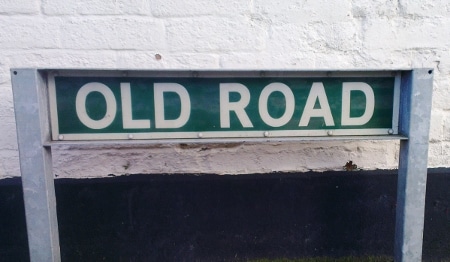
The former road to leading to Longton, Leek etc and known as Cheadle Road (Turnpiked in 1771) then became known as the Old Road (OLD ROAD/OLD ROAD COURT). (Out of interest as you go up Old Road to Oulton Heath you pass a cottage known as Golf Cottage, named because there used to be a golf course there.)
I hope you found this of interest. Next month we shall looks at names associated with people.
Philip Leason
Stone Historical Society chairman
The Stone Historical and Civic Society meets on the third Wednesday of each month from September to June in St Michael’s Hall, Lichfield Street, at 7.30pm. For further information contact Philip by emailing p.leason@btinternet.com