


To mark Remembrance Day, this month’s History Monthly by Philip Leason, the chairman of Stone Historical Society, looks at the role that the people of Stone played in the First World War and recalls the “blackest day in the town’s history”.
Readers who have been following the popular TV programme Downton Abbey will have seen how people responded to the First World War, so this month I thought we would look the role that Stone played and the effect that it had on the town.
There had always been an active volunteer movement in Stone. In 1907 the government passed legislation that resulted in the consolidation of the yeomanry and the volunteers into the Territorial Force. The Territorial undertook various forms of training including rifle shooting in the buts on Downs Banks which had been used by old volunteers.
Another aspect of their training was an annual camp and on 1st August 1914, led by Captain Ridgway, the Stone Territorials had joined with the 5th North Staffordshire Battalion to camp at St Asaph in North Wales. On 3rd August at 1am the order “stand to” was given and the following day Britain was at war with Germany.
Nearly all the Stone Territorials volunteered for active service and returned home to make plans and say goodbye to their families and friends. On 6th August crowds lined the streets and led by the Town Band they left the town (some for the last time) to be kitted out at Hanley and then on for training in Luton.
On 1st April 1915 the 5th North Staffords became part of the 46th North Midland Division and took over a line of trenches in France. In the book on the 5th North Staffords by Lieut. Walter Meakin he describes how the trenches were within 30 yards of the German lines and the troops waist deep in mud and water.

In 1915 the Division mounted an attack on the Hohenzollern Redoubt, a strongpoint in the German line near Loos. On 13th September 700 men of the 5th North Staffords made an attack and 500 of them were either killed or wounded.
In Stone, nearly every family had or knew of soldiers who had been killed and it became known as the “blackest day in the town’s history”. At their meeting on 27th October Stone Urban District Council paid tribute to the gallantry of the men and expressed sympathy for those who had been killed.
As fans of Downton Abbey will be aware, throughout the war Red Cross hospitals were opened throughout the country to accommodate the injured soldiers. In Stone, St Joseph’s Hall was converted into a hospital in June 1916 and by April 1917 had cared for 402 patients.
In addition, Stonefield House in Newcastle Road was converted into another 24-bed hospital.
At home there was a blackout at night and food was rationed. The Girl Guides and women’s groups knitted hats for the troops and made up food parcels. The Guides also provided entertainment for the injured soldiers in the hospitals and helped to collect salvage.
By the end of the War 126 men from Stone, Darlaston and Meaford had been killed and, out of a population of 5,000, 1,100 men had served in the troops. Many of the town’s women had also served in the voluntary organisations and undertaken the work that had previous been done by their menfolk.
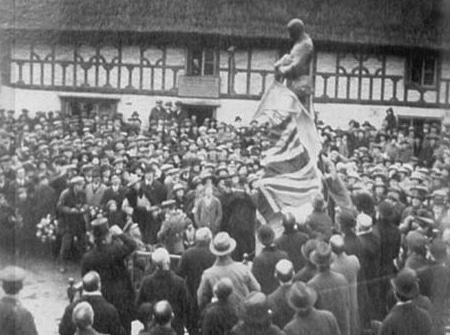
In 1921 the War Memorial in Granville Square, designed by Albert Toft, was unveiled by the Lord Lieutenant Lord Darmouth.
Please make sure that you attend the services of remembrance in Stone this year.




5 comments
cath Turner
My Granddad lived in Lichfield rd Stone. And was in the 5 th north Staffords. Wounded and shot in the jaw. Died 1972. Ernest Edward Ferrie.
Nicky Lawrenson.
My Grandfather, George Sullivan was wounded at the Hohenzollern Redoubt. He was lucky! a mate got him back to the home trenches, even though the soldiers had apparently told to leave the wounded. he had a large piece of shrapnel in the back of his head. He had fiddled his age to join up, as many youngsters did. He spent some time in a recovery hospital with a view of Cheltenham racecourse. His eyesight was very very bad all his life. Hewent on to work on the railway as a plate layer. That’s how he met my Grandmother up at Whiston and lured her to Stone! My mum remembers as a child going up to the Cenotaph with him and having to stop at 11am to observe the prescribed silence, even though they were late. This would probably be in the early 1930’s. He died in 1975, just short of his eightieth birthday.
Jamie Summerfield
Thanks for that Nicky – what a lovely story
BabsinArrod
My grandparents, the Goodills, were based in Stone at The Fillybrooks and my great grand father George Featherstone Goodill, was head gardener at Darlaston Hall so I was fascinated to come across this society as I have photos and newspaper cuttings! Barbara
Craig
Fascinating! Thank you. (Walton resident).