
Sir Gavin Williamson has answered reader questions on Stone, two years after being elected as MP for Stone, Great Wyrley and Penkridge.
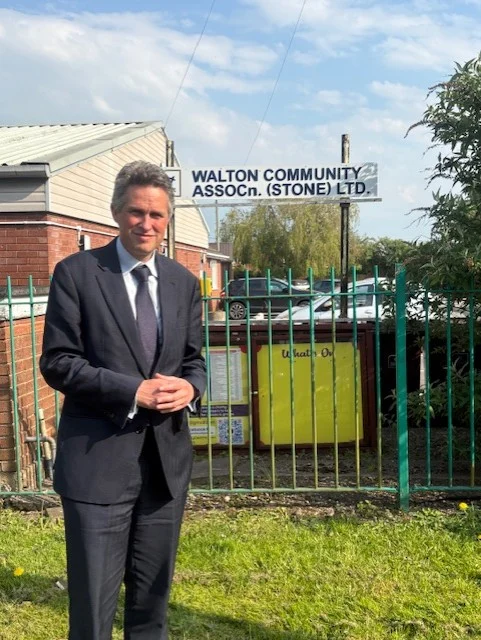
A Little Bit of Stone invited readers to submit questions ahead of the anniversary of the 2024 general election, with responses covering roads, potholes, Stone High Street, planning, housing, health services, SEND provision, anti social behaviour, estate management fees, drainage and the role of an opposition MP.
We received 44 responses, with many people submitting more than one question. Similar questions were grouped together into 12 broad themes and sent to Sir Gavin.
The questions and answers are published below.
Your role as an opposition MP
This is your first period as an opposition MP since entering Parliament. How has that changed the way you work for constituents, and what can Stone residents realistically expect from their MP when he is not part of the governing party?
Being in Opposition naturally changes some aspects of the role, but my priority has not changed at all.
Whether in Government or opposition, constituents rightly expect their MP to be visible, accessible and willing to be a voice for them in the constituency and Westminster. That means helping residents with individual casework, campaigning on local issues, and holding the Government to account.
Of course, being in Government allows you the ability to directly shape policy from within, but opposition can also be a powerful platform to challenge decisions, push for better outcomes, and make sure local voices are heard.
For Stone and the surrounding communities, my focus remains on the issues that matter most locally: protecting our Green Belt from inappropriate development, putting pressure on the County Council to improve our road network and tackling congestion on key routes, supporting Stone High Street and local independent businesses, and making sure our town centre offers a diverse range of local businesses who are at the heart of our community.
Stone is a special place, and my job is to protect what makes it special while making sure it gets its fair share of investment and opportunity. That remains my focus every day, regardless of whether I sit on the Government benches or the Opposition benches.
Local delivery for Stone
Several readers asked what you feel you have achieved for Stone during your first two years as MP. What would you point to as your main local achievements, and what do you feel has not yet been delivered?
Over the last two years, my focus has been on being a visible and active local MP, listening to residents, taking up their concerns, and making sure Stone and the surrounding villages have a strong voice in Westminster.
I am proud of the work we have done to protect our Green Belt and stand up against inappropriate development, which remains one of the biggest concerns for local residents. I have consistently backed local campaigns against large-scale speculative housing proposals, including developments around Stone and Walton, where residents have rightly raised concerns about the impact on infrastructure, roads, local services and the character of our communities. Protecting the identity of Stone and our villages is something I have fought hard for.
I launched the campaign for free parking in Stone to support our High Street and local businesses, helping to highlight just how important accessible town centre parking is for traders and shoppers alike. Supporting local businesses has been a key priority, whether through bringing them together, highlighting their successes in Parliament, or working alongside them to tackle retail crime and anti-social behaviour.
I have also worked closely with local charities and community groups, supporting the fantastic work they do and helping amplify their efforts. That includes backing the Friends of ABC in Walton as they push for better playground facilities for local families and children.
On healthcare, I have worked with local health leaders to push for the return of the cancer bus to Stone, improving access to vital screening services closer to home, while continuing to support stronger local health provision more broadly.
Stone is home to important employers, and I have worked closely with Hitachi as it develops its new plant, ensuring existing jobs remain secure and that new opportunities are created for local people. Protecting and growing high-quality local employment remains a major priority.
I have also stood alongside Stone’s firefighters in pressing for clarity over funding for Staffordshire Fire and Rescue Service, recognising the vital role they play in keeping our communities safe.
On the national stage, I was proud to campaign successfully for the scrapping of the northern leg of HS2, a scheme that would have caused enormous disruption to Stone and the surrounding areas and I remain firmly opposed to any attempt to revive those plans. I have also continued to stand up for local farmers, pushing back against policies that threaten family farms, rural livelihoods, and food security.
Of course, there is always more to do. I know residents want to see further progress on infrastructure, congestion, access to healthcare, and ensuring that local services are delivered to the high standard residents deserve. These are long-term challenges, and I will continue to push for the investment and attention our area deserves.
Being an MP is not about ticking boxes; it is about persistent work, often behind the scenes, to protect and improve the place you represent. That is what I have done over the last two years, and what I will continue to do.
Casework and constituent support
Many of the issues raised by readers are practical local problems involving councils, NHS bodies, utilities, highways, police or government departments. How much of your work is focused on casework, and how should residents contact you if they need help with a local or personal issue?
A huge amount of my work is casework. While people often see the debates and votes in Parliament, much of an MP’s job is helping constituents navigate practical problems in their day-to-day lives.
That can mean anything from dealing with local councils, NHS services, highways issues, policing concerns, utilities providers or Government departments, often when people feel they have hit a dead end and need someone to help cut through the bureaucracy.
My office and I deal with hundreds of cases every month, ranging from planning concerns and road safety issues to healthcare access, anti-social behaviour, local business concerns and problems with public services. For me, this is some of the most important work I do, because it is where you can often make the biggest difference to someone’s life.
I always encourage residents in Stone and the surrounding villages to get in touch if they need help. People can contact me by emailing gavin.williamson.mp@parliament.uk, calling 01785 847027, or visiting my constituency office at 19A High Street, Stone, which is open Monday to Friday from 9am until 5pm.
Roads, potholes and traffic
Roads and traffic were among the strongest themes. Readers raised potholes on Stone’s one way system, the A34, Crown Street, local roundabouts, Christchurch Way, Walton roundabout, Rough Close, bridge closures and traffic around school and commuter times.
What action have you taken with Staffordshire County Council, ministers or other bodies on Stone’s road conditions and traffic problems, and what further action do you want to see?
Roads and traffic are among the issues I hear about most often from residents, and understandably so. Whether it is potholes, congestion, bridge closures or the pressure on key routes at school and commuter times, these are problems that affect people’s daily lives, local businesses, and the wider economy.
I have repeatedly raised these concerns directly with Staffordshire County Council and made clear that residents expect to see faster action and better long-term planning. These issues are also a regular feature of my meetings with the Chief Executive of Staffordshire County Council, where I continue to press the case for Stone. Concerns around Stone’s one-way system, the condition of the A34, Walton roundabout, Christchurch Way, Crown Street, and wider traffic pressures across the town have been brought to me time and again, and I have made sure they remain firmly on the agenda.
Potholes remain one of the biggest frustrations. Residents are fed up with temporary patch-up jobs and rightly want to see proper resurfacing and lasting repairs. That is why I set up my MP pothole reporting tool, so local people can quickly flag issues directly to me and my office, allowing us to chase action and ensure repairs are not overlooked. I would encourage any resident who spots a pothole or road defect to report it.
I have been clear with the County Council that road maintenance cannot simply be reactive. Too often we see the same roads patched up time and time again rather than properly fixed. Residents deserve better than that, and I will continue pressing for a more proactive approach that tackles the root causes.
I have also pushed for much better coordination around roadworks and bridge closures. Too often poor planning creates unnecessary congestion and frustration, especially around school runs and commuter times. Where agencies are not working together effectively, it is local residents who pay the price.
Looking ahead, I want to see stronger investment in Stone’s roads, quicker responses to reported defects, more accountability when repairs are delayed, and a clearer long-term traffic strategy for the town. Stone is growing, and our roads need to be fit for purpose. I will keep pushing the County Council and every relevant authority to make sure our town gets the attention it deserves.
Stone High Street
Readers raised concerns about Stone High Street, including empty units, footfall, traffic restrictions, enforcement of the pedestrian zone, the condition of some buildings, the Crown Hotel, scaffolding and support for independent businesses. What do you think Stone High Street needs, and what role can you play in supporting the town centre?
Stone High Street is one of the town’s greatest strengths. It has a unique character, and a strong independent business community. Protecting that and helping it thrive is incredibly important.
But like many town centres, Stone faces real challenges. Residents and businesses have rightly raised concerns with me about empty units, footfall, traffic restrictions, enforcement in the pedestrian zone, and the condition of some buildings, including long-standing issues like the Crown Hotel and scaffolding that can affect the appearance and confidence in the town centre.
What Stone High Street needs is a clear focus on making it as easy and attractive as possible for people to visit, shop, and spend time there. That means looking seriously at parking, improving access, maintaining a safe and welcoming environment, and ensuring enforcement is sensible and supports the town rather than deterring visitors.
That is one of the reasons I launched my petition for free parking in Stone, because I believe reducing barriers to visiting the High Street is one practical way to support local traders and boost footfall.
I also think we need to continue backing Stone’s independent businesses, which are the backbone of the town centre. I have made it a priority to champion local businesses, highlight them in Parliament, and bring them together to discuss the issues they face, whether that is retail crime, rising costs or attracting more customers into town. Alongside that, I have also been liaising with larger national brands to encourage them to consider Stone as a place to invest and open new stores, helping broaden the offer in the town centre while complementing our excellent independents.
A good example of the practical issues affecting the High Street is Adies Alley, which is a key pedestrian route into the town centre but has remained closed because of scaffolding. I have been regularly pressing the relevant authorities to get this resolved, because improving access into the High Street and removing barriers like this is essential if we want to support local footfall and businesses.
The Crown Hotel is another important issue. I have held regular meetings with the owners because I know how important that building is to the town. It sits right at the heart of Stone, and I want to see progress made much more quickly so that we can finally see plans move forward.
Stone has huge potential, and I want to see it continue to grow as a destination for shopping, food, events and community life. As MP, my role is to be a strong voice for Stone; working with businesses, residents, the council and local organisations to make sure our High Street gets the support and investment it needs.
Stone deserves a town centre that is vibrant, busy and full of confidence, and I will continue to do everything I can to help achieve that.
Planning, housing and infrastructure
A major theme was concern that housing growth around Stone is not being matched by infrastructure. Readers mentioned areas including Walton, Uttoxeter Road, Eccleshall Road, Aston Lodge and Udall Grange. How do you respond to residents who feel local roads, GP access, parking, schools and other services are already under pressure?
These concerns are entirely justified, and they reflect what I have been hearing from residents across Stone for a long time. There is a growing feeling that the area is being pushed to absorb more and more housing without the infrastructure needed to support it.
Areas such as Walton, Uttoxeter Road, Eccleshall Road, Aston Lodge and Udall Grange have already seen significant expansion, and residents are rightly frustrated by the growing pressure this has placed on roads, GP services, school places, parking and other local amenities. People can see with their own eyes that the system is under strain.
What angers many residents, and me, is that too often developers push ahead regardless of local opinion. They see open land and opportunity, but they do not have to live with the consequences. Too often the views of residents are treated as an obstacle to be managed rather than voices to be listened to. That is not right.
I have been outspoken in opposing overdevelopment around Stone and have launched multiple objection campaigns, consultations and surveys to make sure local people have their say and their voices are heard loud and clear. Whether it is protecting the Green Belt, challenging speculative applications or raising concerns about infrastructure capacity, I have made it clear that enough is enough.
I have always said that infrastructure must come first, not after the houses are built. If roads are already congested, GP surgeries already stretched and schools already under pressure, it makes no sense to keep approving developments without a clear plan to deal with those problems.
Developers must be held to account, and Councils must stop allowing housing targets to override common sense and the clear wishes of local communities. Stone is a special place, and I will continue to stand with residents in protecting Stone and the surrounding villages from excessive and inappropriate development.
Planning delays and local business investment
Some local business owners raised concerns about delays in planning validation and approval, and the financial pressure caused when businesses are waiting to open while paying rent, rates and other costs. Is this an issue you recognise in Stone, and what would you like to see done to make it easier for independent businesses to invest locally?
Yes, it is an issue I recognise, and it is one that has been raised with me by a number of local businesses. For independent traders and small businesses in particular, time really is money. Delays in planning validation or approvals can create huge uncertainty and place serious financial pressure on businesses that are ready to invest, employ local people and open their doors.
If a business is paying rent, rates, and other overheads while waiting for decisions, every week of delay matters. That can be the difference between opening successfully or struggling before they have even started trading.
Stone has a fantastic independent business community, and one of the reasons our High Street is so special is because of the local people willing to invest here. We should be making it easier for them to do that, not harder.
I do think there have been frustrations with the Borough Council’s planning process. Too often businesses feel they are left waiting without clear updates, and that lack of urgency can be incredibly damaging. When someone is willing to invest in Stone, create jobs and bring life back into empty premises, the system should be helping them move forward, not holding them back.
What I want to see is a planning process that is quicker, clearer and far more business friendly. That means better communication, faster validation of applications and greater accountability when delays happen. Public bodies need to recognise that every delay has a real economic consequence, not just for the business owner, but for the wider High Street and local economy.
At a time when we are all talking about supporting town centres, the Borough Council has to make sure its processes are working with businesses, not against them. I will continue to raise these concerns and push for improvements, because Stone cannot afford to lose investment through avoidable delays.
Health services and dentistry
Readers asked about NHS dentistry, GP access, disabled parking at health services, the need for a more accessible health centre in Stone, and access to services at Stafford’s County Hospital. What are you doing locally and nationally to improve access to health services for Stone residents?
Healthcare is one of the most important services we all rely on, and making sure people in Stone can access the care they need quickly, easily and close to home is a priority for me.
I have been meeting regularly with local NHS leaders to discuss the pressures facing health services in Stone and the surrounding areas, and to make sure the concerns residents raise with me are being heard directly by those responsible for delivering care.
On NHS dentistry, I know how difficult it can be for residents to find an NHS dentist taking on new patients. That is why I have visited local dental practices to hear their concerns first-hand and better understand the challenges they face, from workforce shortages to pressures in the NHS contract. I have also raised these issues directly with Ministers, because it is clear the current system is not working well enough for patients or providers.
GP access remains a major concern. I regularly hear from residents who are struggling to secure appointments or who feel that local surgeries are under increasing strain as the population grows. I have been raising those concerns directly with local health leaders and making clear that Stone needs the capacity and resources to match demand.
I also know there are important concerns around accessibility, whether that is disabled parking, the layout of health facilities, or the need for a more modern and accessible health centre in Stone. These practical issues can have a significant impact, particularly for older residents and those with mobility issues. I have been working with local health bodies to make the case for better facilities and easier access.
At Stafford’s County Hospital, residents rightly want confidence that services remain strong, reliable, and accessible. I have continued to engage with local NHS leaders on maintaining and improving provision there, because it remains a vital part of healthcare for people in Stone and the surrounding villages.
My approach has always been to work closely with local health leaders, challenge where improvements are needed, and raise issues directly with Ministers when national action is required. Residents deserve health services that are accessible, responsive and fit for the future, and I will continue pushing to make sure Stone gets exactly that.
SEND provision and young people
Several responses raised SEND provision, children and young people missing education, EHCP support, youth mental health, and a lack of local support or social opportunities for young people. What is your view on current provision for children and young people in and around Stone, and what changes are needed?
There is no question that many families in Stone are finding it increasingly difficult to get the support their children need. Whether it is SEND provision, delays in EHCPs, access to mental health support, or making sure young people have opportunities outside school, these are issues that have a huge impact on family life.
I hear regularly from parents who feel they are having to fight far too hard to secure the right support. Too often the system feels slow, complicated and difficult to navigate, particularly when families are already under pressure. That cannot be right.
On SEND, there is a clear need for more capacity, better communication and a system that works much earlier to identify needs and put support in place. Early intervention is crucial. The longer children go without the right support, the harder it becomes for them to thrive in education and beyond.
I am also concerned about the Government’s broader approach in this area. We are seeing far too many young people ending up not in education, employment or training, and that should concern everyone. Every young person who falls into that category is a sign that the system has failed to provide the support, opportunities or intervention they needed at the right time.
The Government talks a lot about opportunity, but the rising number of NEETs shows there is still a serious gap between rhetoric and reality. If we are serious about giving young people the best start in life, there needs to be far greater focus on early support, practical pathways into work and education, and better local services to stop young people drifting out of the system altogether.
Youth mental health is another area where demand has risen significantly. Access to support must be quicker and more consistent, and there needs to be a stronger focus on prevention as well as treatment.
My focus is on making sure local families are listened to, that services are held accountable when things are not working, and that children and young people in Stone get the support and opportunities they deserve.
Anti social behaviour and community safety
Readers raised concerns about anti social behaviour in and around Stone, including e-bikes, smashed bottles, large groups of young people, Westbridge Park, Tilling Drive Park, CCTV and behaviour on the High Street. What do you think should be done locally to improve safety and confidence?
Residents are right to be concerned about anti-social behaviour, because even when it may seem minor to some, it can have a huge impact on how safe people feel in their own community. Whether it is dangerous use of e-bikes, smashed bottles in parks, intimidation by large groups, or disruptive behaviour in the town centre, these issues damage confidence and make people feel that public spaces are not being properly looked after.
I have been working closely with local police and community safety teams to make sure these concerns are being taken seriously. I have raised specific issues around Westbridge Park, Tilling Drive Park, and the High Street, because these are the area’s residents most often mention to me.
One of the biggest frustrations people have is feeling that anti-social behaviour is tolerated for too long before action is taken. I do not accept that. There needs to be earlier intervention, visible policing, and clear consequences for repeated offenders. That means using the powers already available; whether that is dispersal orders, targeted patrols or stronger enforcement where criminal behaviour is involved.
CCTV also has an important role to play. It can act as a deterrent, help identify offenders and provide reassurance to residents and businesses. Where coverage is lacking or outdated, I think we should be looking seriously at how that can be improved..
The message has to be clear: anti-social behaviour should not be dismissed as “part of life” or something residents simply have to put up with. If people are damaging public spaces, intimidating others or making areas feel unsafe, action must be taken. I will continue pressing for that action, because local people deserve to feel safe and proud of where they live.
Estate management fees, drainage and local environment
Some residents on newer estates raised concerns about paying council tax while also paying private estate management fees for open space, drainage ponds and other infrastructure. Others raised concerns about sewage, drainage and the River Trent. What is your position on these issues, and what action do you think is needed from councils, water companies, regulators and government?
These are serious and growing concerns, and nowhere is that clearer than at The Moorings in Stone, where residents have raised significant issues with me about estate management charges and accountability. It is a matter I am actively working on, and it highlights a wider problem for many residents who feel they are being asked to pay twice — once through council tax and again through private management fees for open spaces, drainage ponds and other infrastructure that many assume should already be covered.
That does not feel fair, and I understand why there is frustration. If people are contributing through council tax, there has to be greater transparency about what they are paying for and why additional charges are being levied. Too often residents are left with little control, little clarity and very few options when standards fall short.
I believe there needs to be much stronger accountability for private estate management companies. Residents should have clearer rights, better protections and a proper mechanism to challenge poor service or excessive charges. Too many people feel trapped in arrangements they had little choice over.
On drainage, sewage and the condition of the River Trent, the concerns are just as serious. Residents have every right to expect that local infrastructure is fit for purpose and properly maintained. When drainage systems fail or sewage enters our waterways, it affects homes, communities and the local environment.
Water companies and regulators have to do far better. There needs to be stronger enforcement, more investment in infrastructure, and much less tolerance of failures that affect local communities and the environment.
This comes back to a wider point: infrastructure, accountability and public services must work for local people. When they do not, it is residents who are left dealing with the consequences. I will continue pressing councils, water companies, regulators and Ministers to make sure local people are treated fairly and that these issues are properly addressed.
Looking ahead
As you approach the next stage of this Parliament, and with a change in Prime Minister, what are your main priorities for Stone, and how should residents judge your performance by the next general election?
As we move into the next stage of this Parliament, my priorities remain firmly rooted in the issues that matter most to people in Stone and the surrounding villages.
I want to continue protecting our Green Belt and standing up against excessive and inappropriate development. Residents have been clear that they want to see the character of our communities protected, and I will continue to fight to make sure local voices are not ignored.
I also want to see real progress on local infrastructure, whether that is improving roads, tackling potholes, reducing congestion, or making sure public services keep pace with the demands being placed on them. Too often people feel infrastructure is an afterthought, and that has to change.
Supporting Stone High Street and local businesses will remain a major focus. That means pushing for practical measures like better parking, tackling retail crime, bringing empty premises back into use, and continuing to champion Stone as a place to invest and visit.
Access to healthcare is another key priority. I want to see better access to NHS dentistry, stronger GP provision, and health services that are accessible and responsive to local needs.
Community safety will also remain high on my agenda. Residents deserve to feel safe in their parks, streets and town centre, and I will continue working with the police and local agencies to tackle anti-social behaviour and crime.
Ultimately, residents should judge me on whether I have been visible, accessible and effective — whether I have listened, fought their corner and stayed focused on the issues that matter most to them. Being an MP is about standing up for your area, being present in the community, and making sure local people always have a strong voice in Parliament. That is the standard I will continue to hold myself to.
How constituents can contact Sir Gavin
In his answer on casework, Sir Gavin said residents can contact him by emailing gavin.williamson.mp@parliament.uk, calling 01785 847027, or visiting his constituency office at 19A High Street, Stone, which he said is open Monday to Friday from 9am until 5pm.

See more A Little Bit of Stone in Google
Add A Little Bit of Stone as a Preferred Source to make our stories more likely to appear when you search Google.




1 comment
Alan Lowe
It’s interesting that our MP has met several times with the occupiers of the Crown Hotel and has made representations on the closure of Adies Alley.
There has been no physical progress on The Maltings, the derelict building that caused the closure of this busy thoroughfare and right-of-way. This has been going on for well over a year and all that can be seen is a long piece from an architect employed by the Crown Hotel’s occupier, telling us what a wonderful history The Maltings had and how Stafford Borough Council had granted planning permission for it to be converted into hotel rooms and a gym. This followed an application for planning permission for emergency works to dismantle much of the building and rebuild it since the wall facing the alley was structurally dangerous.
None of those emergency works have been undertaken, some nine months after that application. Adies Alley remains blocked.
When a person or organisation applies to carry out works, especially on a building that it has failed to maintain over a lengthy period, it is worth checking their history in such matters.
Perhaps it should be no surprise that the organisation occupying the Crown Hotel and responsible for The Maltings also holds an increasing number of other hotels that turn out to be old and appear dilapidated. It is also worth looking at the room rates to see where they see themselves in the market. Well-run, good hotels require regular investment and demand high room rates to finance this and deliver profits.
I suggest that local people and certainly the planners, building control and planning committee members at Stafford Borough Council do some simple searches for some of this information. If they discover that the people responsible for The Maltings and the cause of the closure of Adies Alley have a strong record of investment and of upgrading their properties, we might hope that their planning permission has a genuine intent to carry out the works. If they discover something different, perhaps councillors might direct officers to enforce the law and thus permit the taxpayers and voters of Stone to regain access to Adies Alley.
Perhaps our MP might care to pick up this responsibility. Since the alley opens out very close to his constituency office on Stone High Street, it must be some concern to see this major pedestrian access route blocked because of one intransigent business, damaging several others.